A Mountain Guide's Fight for Justice
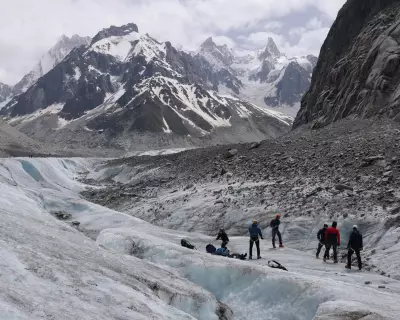
Saúl Luciano Lliuya, a Quechua-speaking mountain guide, farmer, and father from the Peruvian Andes, has seen his world change irrevocably. The glaciers that have always dominated his landscape are now receding at an alarming rate, a direct consequence, he argues, of climate change driven by major industrial polluters.
On 28 May, a German court delivered a significant blow to his quest for justice. The higher regional court of Hamm dismissed his groundbreaking lawsuit against the German energy giant RWE. The case was thrown out on the grounds that there was no concrete threat to Saúl’s home, despite the court acknowledging that major greenhouse gas emitters could, in principle, be held accountable for their emissions under German law.
Life in the Shadow of the Melting Peaks
Saúl's life is intimately connected to the mountains of Huaraz, Peru, where he was born at an altitude of 3,100 metres. From his home, the snow-capped peak of Nevado Churup looms close. As a farmer and guide, he has witnessed the transformation of his environment firsthand.
He recalls a ravine near Quilcayhuanca that was once teeming with life. There were many more wetlands, it had more life, he remembers. There were more ducks, other birds... I remember birds flying almost like they were in the sea. Now, the grass is sparser, the waterfalls fewer, and the native deer, the taruca, are a rare sight.
The most profound change is the slow, visible melting of the glaciers. It makes you feel sorry for the mountains, Saúl confesses. You feel sad about what’s happening, and it creates a feeling of helplessness.
The Looming Threat of Lake Palcacocha
This glacial melt has created a new and deadly threat. Lagoons have formed, and one in particular, Lake Palcacocha, poses a catastrophic risk. In 1941, an avalanche fell into the lake, causing it to overflow. The resulting mudslide killed between 18,000 and 20,000 people.
Since that disaster, the Palcacocha lagoon has grown 34 times its 1941 size due to continued glacial melt. Experts warn that if another avalanche occurs, the flood would follow the same path, directly endangering the 50,000 people who now live in the repopulated risk zone—including Saúl and his family.
Despite his grandfather's warnings about the area being a prohibited building zone, municipalities allowed construction to expand. If a landslide were to occur, my house would be affected, Saúl states. He feels the community has been abandoned, with no significant infrastructure projects like dams or reservoirs to mitigate the risk.
The Landmark Lawsuit and Its Legacy
Saúl's sense of helplessness changed in 2014 after meeting the German NGO Germanwatch during the Cop20 climate conference in Lima. They presented him with a radical idea: suing those responsible for the emissions driving the changes.
His lawsuit against RWE was unprecedented. It argued that since RWE had contributed an estimated 0.47% to global climate change—reportedly more than the entire nation of Peru—it should be held partially accountable for the local risks. The suit sought €17,000 (approximately £15,000) from the company, representing its share of the cost for protective measures like a new dam.
Although dismissed, the case has paved the way for a new wave of climate litigation. Saúl has been told that 45 to 60 similar lawsuits are now pending against other polluting companies. To hear that the effort, the lawsuit, is somehow paving the way for other lawsuits... that's good, isn't it? he reflects.
For Saúl, this fight is deeply personal. He thinks of his family, his parents, and his children. He sees fellow farmers living in poverty, who haven't contributed to climate change yet are suffering its most severe consequences. His hope is simple but profound: I just hope the mountains don't disappear completely. The glaciers are not just scenery; they are the source of water for farms and cities alike. Their disappearance would be a tragedy for an entire way of life.