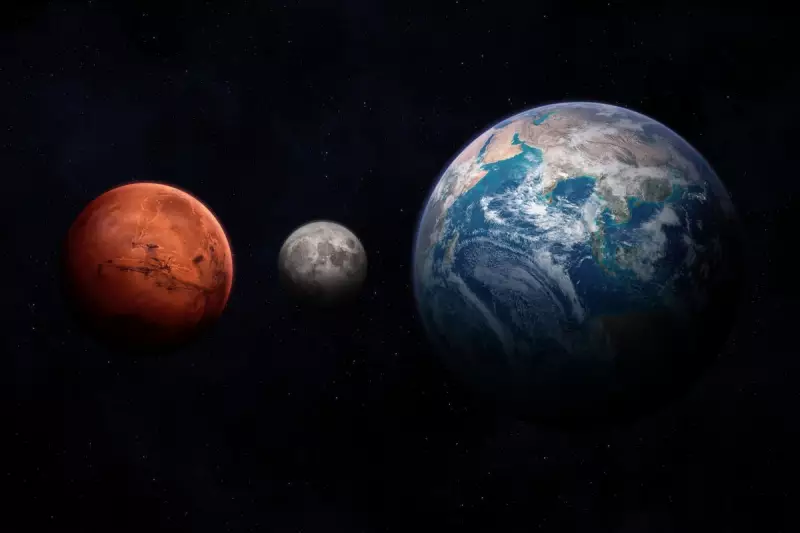
New scientific research has uncovered a profound and previously underappreciated connection between our planetary neighbour and Earth's long-term climate history. Computer models now reveal that Mars's gravitational pull plays a significant role in shaping the cycles that govern ice ages on our own world.
Gravitational Tug from the Red Planet
Despite being half the size of Earth and possessing only a tenth of its mass, with its closest orbital approach still over 33 million miles away, Mars exerts a measurable gravitational influence on our planet. This influence operates on a vastly different timescale to the Moon's daily effect on ocean tides, instead modulating climate patterns over hundreds of thousands to millions of years.
Professor Stephen Kane, a planetary astrophysicist at the University of California, initiated the research project after reviewing studies that linked subtle shifts in Earth's climate to faint gravitational interactions with Mars. "I knew Mars had some effect on Earth, but I assumed it was tiny," Professor Kane stated. "I'd thought its gravitational influence would be too small to easily observe within Earth's geologic history. I kind of set out to check my own assumptions."

Modelling the Solar System's Dance
Previous investigations had suggested that patterns recorded in deep-sea sediment layers corresponded to long-term climate cycles potentially influenced by Mars. Professor Kane's team adopted a novel computational approach, running extensive simulations of the solar system's dynamics. These models focused on the long-term variations in Earth's orbit and axial tilt, known collectively as Milankovitch cycles.
These orbital and positional cycles are fundamental to understanding how sunlight distribution changes across the planet's surface over immense timescales, thereby dictating the onset and conclusion of ice ages. An ice age is defined as a prolonged period where permanent ice sheets exist at the poles. Earth has experienced five or six major ice ages throughout its 4.5-billion-year history.
Mars's Signature in the Ice
The computer simulations yielded a striking result. The research team discovered that Mars's gravity has a particular and measurable influence on shorter climatic cycles nested within the broader ice ages. The models identified two key cycles directly affected: one lasting approximately 100,000 years and another spanning around 2.3 million years.
We are currently living within the Quaternary Ice Age, which began 2.6 million years ago. This period reached its glacial maximum during the Anglian stage, when ice sheets extended as far south as the Isles of Scilly off Cornwall and to the area that is now north London. Within such major ice ages, which last for millions of years, there exist smaller fluctuations in global ice volume, and Mars's gravitational pull appears to be a key modulator of these rhythms.
"Without Mars, Earth's orbit would be missing major climate cycles," the research concludes, highlighting the intricate gravitational ballet of our solar system and its direct consequences for life on our planet. This finding underscores the complex, interconnected nature of planetary science and climate history, where a distant, seemingly insignificant neighbour can leave a definitive mark on Earth's geological record.