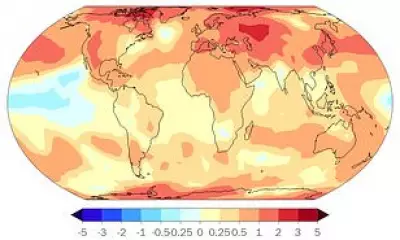
Scientists have issued a stark warning after revealing the unprecedented amount of excess heat absorbed by the world's oceans during 2025. According to a major new assessment, the seas took in a colossal 23 zettajoules of thermal energy last year, marking the highest level ever recorded.
A Staggering Scale of Warming
The research, led by experts from the Chinese Academy of Sciences, quantifies the immense burden placed on the planet's primary heat reservoir. To grasp the scale, 23 zettajoules equates to 23,000,000,000,000,000,000,000 Joules – enough energy to boil approximately 69 quadrillion kettles. This record was set despite 2025 being influenced by a cooling La Niña climate pattern at its start and end.
Celeste Saulo, Secretary-General of the World Meteorological Organisation, emphasised the underlying trend, stating, 'Yet it was still one of the warmest years on record globally because of the accumulation of heat-trapping greenhouse gases in our atmosphere.' The data confirms that 2025 was the third hottest year globally on record, following 2023 and 2024.

Ocean as the Climate's Heat Sink
While floods, droughts, and heatwaves manifest on land, the ocean silently bears the brunt of human-induced warming. It absorbs more than 90 per cent of the excess heat trapped by greenhouse gases. The study's authors explain that 'ocean heat content (OHC) reflects the accumulation of heat stored in the ocean, it provides one of the best indicators of long-term climate change.'
The warming was not uniform across the globe. By combining data from institutes across Asia, Europe, and America, researchers identified the fastest-warming regions in 2025. These included the tropical and South Atlantic, the North Pacific, and the Southern Ocean. Critically, the team noted that 'ocean heat content reached a record high in 2025 as it has in each of the past nine years,' underscoring a relentless upward trend.
Dire Consequences and a Call for Action
The consequences of this stored heat are severe and multifaceted. The experts warn it is devastating marine ecosystems and driving global sea-level rise through thermal expansion, where warmer water takes up more space. Furthermore, it supercharges the climate system. 'Rising ocean heat drives global sea-level rise via thermal expansion, strengthens and prolongs heatwaves, and intensifies extreme weather by increasing heat and moisture in the atmosphere,' they stated.
The accumulation of heat and moisture directly fueled the extreme weather events – from intense tropical cyclones to heavy rainfall and severe heatwaves – witnessed around the world in 2025, highlighting the critical need for robust early warning systems.
The researchers conclude with an urgent call to curb global emissions, asserting that 'the biggest climate uncertainty is what humans decide to do.' They express hope that, collectively, society can 'reduce emissions, better prepare for upcoming changes, and help safeguard a future climate where humans can thrive.' The findings add immense pressure for nations to adhere to and strengthen their commitments under the Paris Agreement, which aims to limit global temperature rise to well below 2°C.