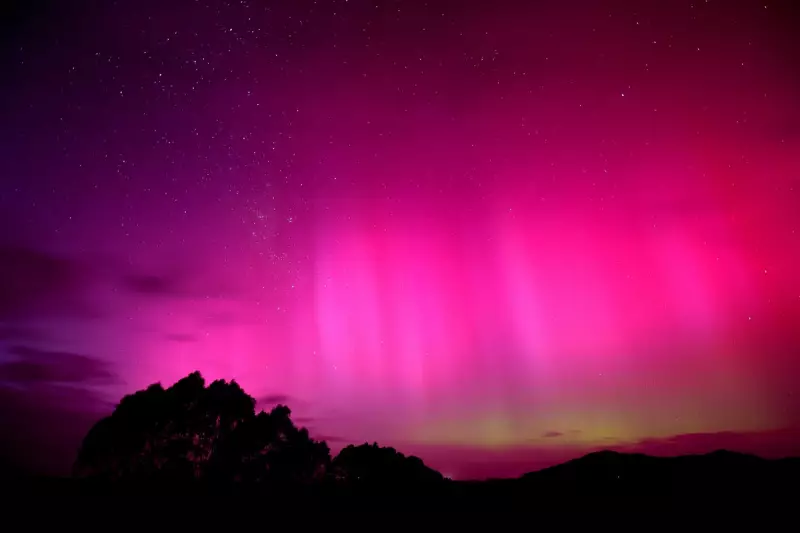
A historic solar storm has delivered an extraordinary celestial spectacle across Australia, with the aurora australis visible from multiple regions simultaneously in a rare event not witnessed in over twenty years. The southern lights, typically confined to far southern latitudes, were observed as far north as Queensland on Tuesday night, creating a breathtaking natural light show.
Unprecedented Visibility Across the Continent
Skywatchers from Tasmania, Victoria, New South Wales, and even central Queensland reported vivid auroral displays featuring vibrant hues of green, purple, and pink. The phenomenon was powerful enough to be seen with the naked eye, prompting an outpouring of spectacular images across social media platforms as Australians shared their experiences of this remarkable event.
The Science Behind the Spectacle
The spectacular display results from charged particles ejected from solar storms, known scientifically as Coronal Mass Ejections, colliding with molecules in Earth's upper atmosphere. These accelerated electrons follow our planet's magnetic field toward the polar regions, where they interact with oxygen and nitrogen atoms approximately 100 kilometres above the Earth's surface.

When these collisions occur, electrons transfer energy to atmospheric molecules, exciting them to higher energy states. As the molecules subsequently relax back to their normal energy levels, they release this excess energy as visible light, creating the mesmerising auroral displays that captivated observers across the southern hemisphere.
Experts Highlight the Rarity
Astrophysicist Sara Webb from Swinburne University emphasised the unusual nature of this event, telling ABC News that it is "rare" for auroras to be visible from so many parts of Australia simultaneously. Typically, southern lights are only observable from latitudes below 35° South, making Tuesday night's widespread visibility particularly exceptional.
The Australian Bureau of Meteorology confirmed the unusual strength of the event, noting that while the far south of the country typically offers the best aurora viewing opportunities, this solar storm was sufficiently powerful to allow photographic captures from central Queensland - a latitude where such phenomena are virtually never witnessed.
Solar Maximum Activity Continues
Space weather experts indicate that these intense auroras and their underlying solar storms signal that the Sun remains in its Solar Maximum phase - the peak period of heightened activity within its approximately 11-year magnetic cycle. This increased solar activity explains the frequency and intensity of recent space weather events affecting Earth's atmosphere.
The Australian Space Weather Forecasting Centre had issued specific aurora alerts for Tuesday night, accurately predicting the spectacular display that followed. Their monitoring systems detected the incoming solar storm that would trigger this historic event.
Future Viewing Opportunities
While solar wind speeds are predicted to decline throughout Wednesday and Thursday, creating relatively fainter displays, the Bureau of Meteorology suggests that southern lights may still be visible this week under optimal conditions. The bureau indicated that "people in Victoria, Tasmania and southern Western Australia may still have a chance to capture the lights on the southern horizon," though the displays will likely be weaker than Tuesday's record-breaking event.
This extraordinary celestial event serves as a powerful reminder of our planet's connection to solar activity and provides both scientific insight and public wonder about the natural phenomena occurring in Earth's upper atmosphere. The widespread visibility across Australia represents a unique opportunity for both professional astronomers and amateur skywatchers to observe and document these remarkable atmospheric interactions.