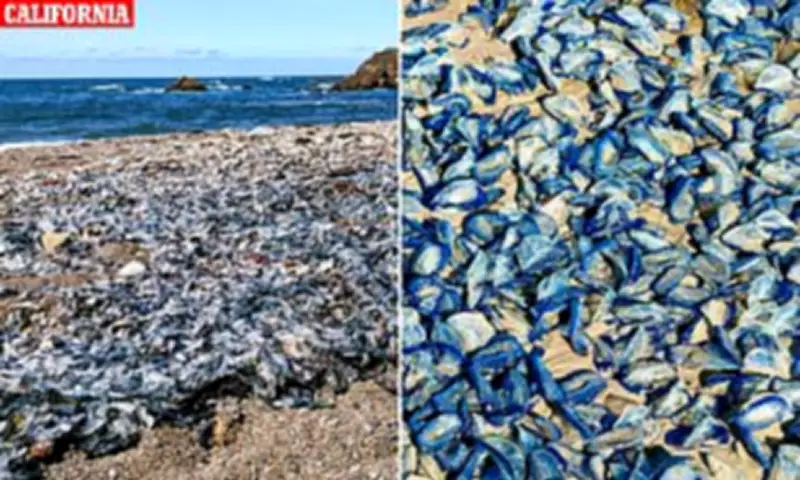
Thousands of bright blue sea creatures have washed up along Southern California beaches, leaving locals stunned and searching for answers. The oval-shaped blobs have been spotted covering swaths of Jenner, about two hours north of San Francisco, as well as other beaches on the West Coast.
What Are These Creatures?
The creatures, known as Velella velella or 'by-the-wind sailors,' are small, free-floating marine predators. Though they resemble jellyfish, they are not actually jellies and are related to corals, anemones, and hydroids. Velella velella are flat, oval-shaped blobs which typically grow to about three to four inches as adults. Their stinging cells are rarely harmful to humans, according to the National Park Service (NPS).
How Do They End Up on Beaches?
They do not suddenly appear but are typically carried by shifting winds, such as during a storm, which can sweep them ashore in massive numbers. Once stranded, they eventually dry out and become brittle, transparent, and pungent. Velella velella took over a beach in Jenner, California, about two hours north of San Francisco. The flat, oval-shaped blobs were also spotted on the shores of Goleta, about 10 miles west of Santa Barbara.

Pictures also showed the blue creatures taking over shores in Goleta, about 10 miles west of Santa Barbara. They were spotted at Baker Beach, Crissy Field, and Ocean Beach in San Francisco, per the San Francisco Chronicle, as well.
Why Are They Called 'By-the-Wind Sailors'?
Although Velella velella are known as 'by-the-wind sailors,' that name refers to how they have a flexible two-inch-high triangular sail attached to their body. Velella velella cannot actively control their direction and instead drift wherever the wind takes them. This happens occasionally in Southern California and across the West Coast as a whole.
The mysterious blue blobs are described as 'relatively common' by the NPS, but they are only usually observed onshore when guided there by winds. They are not known to be dangerous to humans, but the Pacific Beach Coalition has warned that 'it's wise to just look and not touch any living Velella that you come across.'
Are They Dangerous to Dogs?
However, the creatures can be harmful to dogs who eat them while on the beach, potentially causing vomiting, diarrhea, and other gastrointestinal issues. 'If you notice that they are pawing at their face or hyper-salivating, there's a good chance that they might have licked one or eaten it,' Dr. Brieana Sarvis, the hospital director of San Diego Humane Society's Escondido campus, previously told KGTV. 'They can be so hard to see, you may not even see your dog contact them,' Sarvis added.
When and Where Do They Appear?
Scientists say the Velella velella's movement patterns are unpredictable, according to the Scripps Institution of Oceanography. However, they usually end up on Southern California beaches around late spring and early autumn due to local wind patterns and food availability. However, this does not happen every year, keeping their sightings relatively rare.
The creatures washing ashore has also been reported elsewhere in California, including Cayucos, about four hours south of San Francisco. The creatures began washing ashore there as early as April 14, according to a Facebook post by the coastal town. Large numbers have also been seen along Monterey County beaches, according to CBS News. Clusters have been sighted in the Santa Barbara Channel and along nearby beaches, per the Santa Barbara Independent. Then, they have also been spotted on beaches in La Jolla, Pacific Beach, and Coronado, according to KUSI-TV. Further north, the creatures have also been sighted along the Oregon coast.