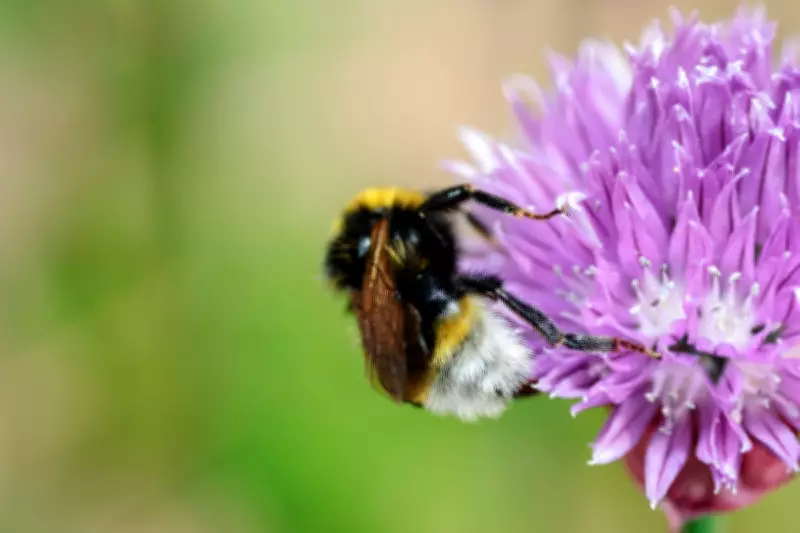
As World Bee Day approaches on 20 May, offering a timely reminder of pollinators' vital role in food security, biodiversity, and ecosystem health, many might find themselves pondering the intricate lives of the bees buzzing through their gardens. Distinguishing a common buff-tailed bumblebee from its parasitic cuckoo relative, or understanding which species can sting and which prefer a bee hotel to an underground nest, can seem a daunting task.
Fortunately, expert guidance is at hand. Dave Goulson, founder of the Bumblebee Conservation Trust and a professor of biology at Sussex University, offers a comprehensive insight into these fascinating insects in his new publication, The Bee Spotter’s Guide.
Goulson reveals that bees exhibit a surprising diversity in their habitats, from burrows and tree holes to even empty snail shells. Many also have favourite flowers, with some males even sleeping curled up within blooms. "Quite a lot do that, because the males don’t typically have a nest. Flowers provide a bivouac for the night," Goulson explains. He adds, "The males of all bees are pretty useless creatures. Their only job is mating. They don’t gather food for the nest. In the daytime they often sit on flowers, having a bit of a drink to fuel their next search for a mate."

Buff-tailed Bumblebee
The Buff-tailed Bumblebee stands out as the UK’s most prevalent bumblebee, found across the country. Goulson describes it as "one of our biggest bumblebees, on the wing from late February right through to summer. It has two yellow stripes and a slightly brownish bottom, hence the name ‘buff-tailed’." Queens emerge from hibernation in early spring, feeding on flowers before seeking out underground nests, often seen flying low to the ground. They favour plants such as lavender, catmint, and borage, though they will feed on many others.
Southern Cuckoo Bumblebee
A more sinister presence is the Southern Cuckoo Bumblebee, aptly named for its parasitic behaviour. "As the name suggests, it’s a bit like the bird – it specialises in attacking nests of buff-tailed bumblebees," Goulson reveals. The female emerges later than its host, targeting established buff-tailed nests. "If they find one, they murder the queen. They are big, strong insects with a thicker skin and a longer sting than normal bumblebees, and kill the queen, then they basically enslave her worker bees into their own workforce." Despite their aggressive nature towards other bees, they pose no threat to humans. They share similar yellow stripes with the buff-tailed bumblebee but possess an additional yellow marking near the white on their tail. Males are particularly drawn to brambles.
Red Mason Bee
Challenging the common perception of bees living in hives, the Red Mason Bee is one of the UK’s most common solitary bees. Goulson clarifies that while honey bees and over 20 bumblebee species are social, "In the UK we have about 270 species of bee, so roughly 250 of them are solitary insects which means that the female makes a nest on her own and there are no workers. She just rears sons and daughters." Females are identifiable by their inward-curved horns, used to gather and mould damp soil for their brood cells. These bees are frequent occupants of 'bee hotels' and other horizontal tunnels, active only in April and May. "They are quite small, red and fluffy, and are called mason bees because the female bee nests in holes. They cannot sting humans. The stings of most solitary bees species are too weak to penetrate human flesh," Goulson assures. They are vital pollinators for apples and pears, and can also be found on forget-me-nots, grape hyacinths, rosemary, and pulmonaria.
Hairy-footed Flower Bee
The Hairy-footed Flower Bee, a personal favourite of Goulson’s, is a relatively large solitary bee. Males, fluffy brown, appear in early spring, followed by jet-black females with distinctive orange hind legs a week or two later. Its name derives from the male’s midlegs, which feature long hairs. "When he’s courting the female bee he brushes her face with his hairy feet. It seems to work," Goulson notes. Females burrow into clay banks for nesting and exhibit a unique hovering and darting flight pattern. Their preferred plants include comfrey and lungwort.

Wool Carder Bee
Finally, the Wool Carder Bee is a striking solitary species, marked by bright yellow spots along its abdomen. Its name reflects the female’s habit of collecting hairs from fuzzy-leaved plants to construct nests resembling cotton wool. The male of this species is notably aggressive. Goulson explains, "They look for a patch of lamb’s ear and defend it against any other bee, not just their own species but any other insect, in fact, that comes into the patch (but not humans)." These males will "fly at it and have these big pointy bumps on the underside of their body which they’ll stab at any insect that dares to enter their territory and crush it," all to protect resources for the female. Common in southern England and south Wales, wool carder bees are active from late May to early August, nesting in cavities and readily utilising man-made opportunities. They use lamb’s ear for nest building and feed primarily on woundworts and legumes like bird’s-foot trefoil.
Understanding these diverse and often overlooked creatures can enrich our appreciation for the natural world. For those inspired to delve deeper into the fascinating realm of pollinators, The Bee Spotter’s Guide by Dave Goulson is available now from National Trust Books, priced at £9.99.