Mass Stranding of Whales on Scottish Beach Attributed to Pod Loyalty During Difficult Birth
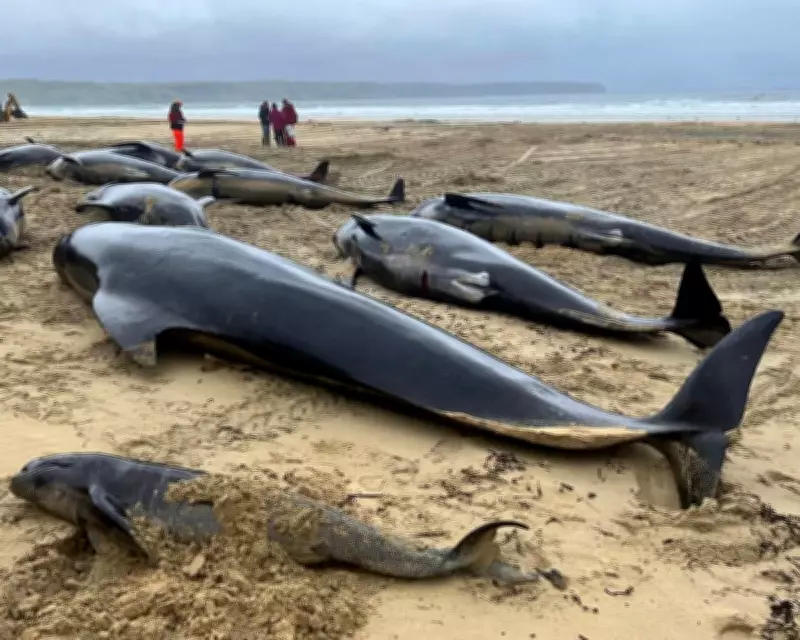
A comprehensive report has concluded that the tragic mass stranding and subsequent euthanasia of 55 pilot whales on the Isle of Lewis in 2023 was primarily caused by the mammals' profound loyalty to their pod. The incident, which occurred at Tràigh Mhòr beach in Tolsta, has been the subject of extensive scientific investigation to determine the underlying factors behind this unusually large-scale event.
Initial Suspicions and Scientific Findings
Initially, researchers considered various potential causes, including trauma, disease, or acoustic disturbances from military or industrial noise. However, the report from the Scottish government's Marine Directorate points to a convergence of biological, behavioural, and environmental factors. Specifically, the highly social long-finned pilot whales died because the group was following a female whale who was experiencing a prolonged and difficult birth.
Dr Andrew Brownlow, the lead scientist of the investigation conducted by the Scottish Marine Animal Stranding Scheme (Smass), emphasised the complexity of such events. "The Tolsta event is a reminder that mass strandings are rarely the result of a single cause," he stated. "Rather, they emerge at the intersection of individual physiology, group social behaviour, and external marine environmental conditions."

Detailed Analysis of the Stranding Event
The report indicates that the whales were in good health prior to the stranding. However, they appeared to move into shallow water while following a single compromised female. Postmortem examinations confirmed that the female whale was undergoing a difficult birth, which acted as a trigger for the pod's fatal movement into the shallow bay.
Observations noted that the whales were seen milling near the shore before becoming stranded. Dr Brownlow explained that such behaviour, where a pod gathers to support a sick or injured member, is crucial for survival in offshore environments as a defence mechanism against predators. "If a member of the pod was in distress, this species' well-documented social cohesion would have led others to aggregate closely in a protective response," he said.
Environmental Factors and Acoustic Traps
In this instance, that protective behaviour appears to have drawn the group into the shallow, sandy bathymetry of Tràgh Mhòr. The bay's gently sloping seabed and suspended fine sediments may have created an acoustic trap, attenuating echolocation signals and diminishing the group's capacity to navigate safely back to deeper water. Unable to return to the ocean, the whales had to be euthanised on the shore to prevent further suffering.
Broader Implications and Related Incidents
The scientists' findings are particularly crucial as they attempt to understand the stranding of a further 77 animals of the same species on Sanday beach, Orkney, almost a year later. That incident, one of the largest recorded on UK shores, is still under investigation by Smass.
Long-term monitoring data from the organisation indicates that mass strandings of whales and dolphins in Scottish waters have increased in scale and frequency by up to 300% over the past 30 years. Other recent reports on pilot whale strandings support Smass's conclusion that human-created sound was not a factor in these specific events.
Contrasting Cases and Ongoing Concerns
However, contrasting incidents have raised concerns among scientists. For example, 10 sperm whales were beached in January and February in locations including Cornwall, Denmark, and Germany. The unusual strandings of these large-toothed whales have prompted worries that military or industrial sound pollution may be driving deep-diving whales into shallow waters where they cannot feed effectively.
This highlights the ongoing need for research into marine environmental changes and their impacts on cetacean behaviour. Understanding these complex interactions is essential for improving our ability to anticipate, interpret, and potentially mitigate the effects of a changing ocean on marine life.