The Allure of Autumn Moth-Trapping
On a damp November evening in Allendale, Northumberland, a dedicated naturalist defies the forecast and sets her moth trap, hoping the 10C temperature will entice late-season species into revealing themselves. This practice, often associated with summer, continues to yield fascinating discoveries deep into autumn, demonstrating nature's resilience during the colder months.
Nature's Waterproof Design
Many assume moths avoid rainy conditions, but they possess remarkable evolutionary adaptations. Their wings feature super-hydrophobic properties, with microscopic scales overlapping like roof tiles and angled surfaces that cause water droplets to simply roll away. While wind remains challenging, rain proves little obstacle to these determined fliers.
Winter's Winged Residents
The first discovery appears on the wall beside the trap: a handsome December moth (Poecilocampa populi), appearing characteristically early despite its name. This male specimen displays resplendent, comb-shaped antennae designed to detect female pheromones across great distances. Its furry head resembles a Cossack hat, while charcoal grey and russet wings with cream cross lines provide insulation against the cold.
Since beginning participation in the Garden Moth Scheme, the observer has recorded December moths every winter, benefiting from her garden's proximity to woodland where larvae feed on broad-leaved trees.
The moth trap itself consists of a large black tub positioned beneath a bright bulb, funneling light-attracted moths downward into textured egg boxes. The careful examination of these hollows creates moments of discovery that make moth trapping consistently engrossing.
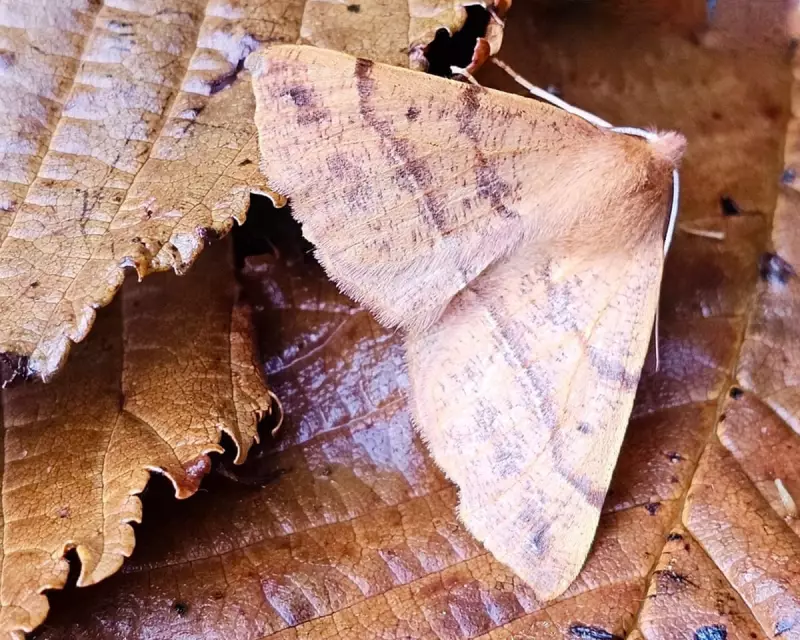
November reveals an expected mix of species: red-green carpet, small wainscot, chestnut and winter moths, all demonstrating remarkable camouflage adaptations to different backgrounds within the landscape. Using a wooden coffee stick, the naturalist gently lifts a feathered thorn moth onto fallen leaves for photography, where its warm tones instantly blend with autumn's palette.
The Standout Discovery
While winter moth-trapping offers a more muted experience compared to summer's abundance, one particular find brings special delight. The angle shades moth presents a complexity of triangles and scalloped edges, creating visual tricks through geometric patterns that perfectly imitate the crisp forms of dry leaves.
The observer recalls her first encounter with this species in an old walled garden, where its elaborate design sparked a long-lasting fascination with moths. This November discovery rekindles that original wonder, proving that nature's marvels continue through the colder seasons.
Unlike the hurly-burly of summer trapping, this winter session yields just a few specimens to record, but each reveals the quiet persistence of nature and the rewards of patient observation during months when many assume insect activity has ceased.