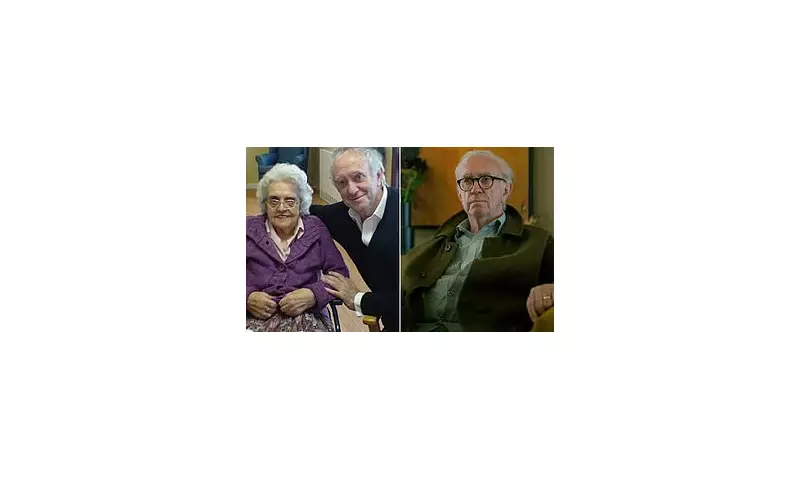
Acclaimed actor Sir Jonathan Pryce possesses a profound and personal understanding of dementia's cruel progression. His insight stems not only from witnessing the decline of his cherished Aunt Mair but also from immersing himself in the minds of characters grappling with the condition, delivering performances that have resonated deeply with audiences worldwide.
Portraying the Unravelling Mind on Screen
Having established a legendary career on stage and screen in productions like Brazil, Evita, and James Bond's Tomorrow Never Dies, Sir Jonathan's recent work has taken a more reflective turn. Since 2022, he has captivated viewers as David Cartwright, a retired MI5 spymaster in Apple TV+'s Slow Horses. The series charts the gradual disintegration of Cartwright's formidable intellect as dementia takes hold, a decline painfully witnessed by his grandson, River, played by Jack Lowden.
'You see a lot of it through River’s eyes – how he starts looking at his grandfather, whom he loves dearly, in a different way,' Sir Jonathan explains. He praises writer Will Smith for his commitment to 'exploring the condition and the impact it has, in a very positive and meaningful way.'

This year, he also appeared on the big screen as Stephen Best opposite Helen Mirren in the film adaptation of Richard Osman's The Thursday Murder Club, playing a man with dementia who ultimately solves a murder. 'I felt a great responsibility in taking it on,' Sir Jonathan says of these roles. 'You want it to speak to people, and yet you want to tread that line between making light of the disease and capturing how it can change a person from their very core.'
A Personal Crusade Inspired by Aunt Mair
It is in memory of his Aunt Mair that Sir Jonathan is now lending his voice and support to the Daily Mail’s Defeating Dementia campaign, in association with the Alzheimer’s Society, for which he serves as an ambassador. This vital initiative aims to boost early diagnosis, accelerate research, and improve care for a condition that is now the UK's biggest killer, claiming 76,000 lives annually – one in nine of all UK deaths.
'It’s shocking how nothing can be done once it takes hold,' Sir Jonathan states. He recalls a time when terms like 'Alzheimer’s' were rarely used, and attitudes were less sympathetic. 'You’d say they were “senile” or “doolally”. That’s changed enormously now, but we still have a long way to go.'
His Aunt Mair, a 'second mother' to him and his sisters, was a fiercely independent and witty Welshwoman. As she reached her 90s, the signs began to show. 'One day I went to visit and she didn’t remember me,' he recalls. 'I was very upset.' His son offered a poignant perspective: 'He said, “No, Dad. She remembers you. She just doesn’t recognise you”.'
Watching her memories fade was heartbreaking. She eventually had to sell her home to pay for care. Yet, glimmers of her character remained; she never lost her humour, famously retorting to a doctor who asked if she knew who he was: 'Well if you don’t know who you are, I’m sure I don’t.'
From Stage to Advocacy: A Therapeutic Journey
Sir Jonathan's first professional exploration of dementia came in 2018's stage play The Height of the Storm. The experience was 'therapeutic' for him, prompting reflection on grief and loss. More importantly, it revealed the power of representation. 'After each performance, people would tell me how much the play meant to them because they were caring for a parent or had lost a parent to Alzheimer’s,' he shares. 'Some said it was the first time they hadn’t felt alone.'
This direct connection with audiences solidified his commitment to advocacy. His work has also led him to reconsider his own father's death following a violent attack in the 1970s. 'Knowing what I know now, I wonder if he had developed dementia by the end... Something definitely changed,' he reflects.
Now in his late seventies, ageing is on his mind. He lives with his wife, actor Kate Fahy, in a London townhouse but acknowledges, 'Some time in the not-too-distant future we’ll have to sell it and move somewhere smaller.' He is determined not to be a burden on his three children but is grateful for their close bond.

Sir Jonathan concludes by highlighting the crisis in social care, driven by underfunding and staff shortages. 'Having been in hospital... I’ve seen the best and the worst of it,' he says, recalling a frightening encounter with a bullying nurse. 'It gave me an insight into what that can be like if you’re an older person... It’s one of the reasons the Alzheimer’s Society is doing such important work.'
Sir Jonathan Pryce is supporting the Alzheimer’s Society fundraising prize draw with Omaze, offering a £5 million house. For confidential advice on dementia, call the Alzheimer’s Society’s Dementia Support Line on 0333 150 3456.