The Psychology of Signature Size: What Your Handwriting Reveals
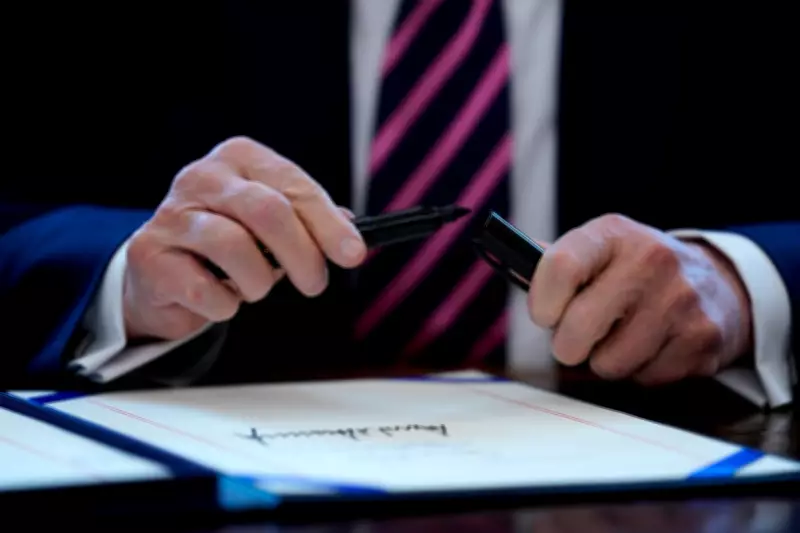
For years, the distinctive, large and bold signature of Donald Trump has captured public attention. It recently emerged that his signature appeared in a book given to Jeffrey Epstein for his 50th birthday, fitting neatly with Trump's history of brash self-adulation. "I love my signature, I really do," he said in a September 30, 2025, speech to military leaders. "Everyone loves my signature." This signature is of particular interest to psychologists studying the connection between signature size and personal attributes.
An Accidental Discovery in a University Library
More than 50 years ago, as an undergraduate work-study student in Wesleyan University's psychology library, I made an unintentional empirical discovery. My task was to check out and reshelve books, with borrowers signing their names on orange, unlined cards. I noticed a pattern: faculty members used a lot of space to sign their names, while students used very little, leaving ample room for future readers.
I decided to study this observation systematically. Gathering at least 10 signatures for each faculty member and comparison samples of student signatures with the same number of letters, I measured the space used by multiplying height versus width. The results showed that eight of nine faculty members used significantly more space. To test for age and status, I compared signatures of blue-collar workers, professors and students on blank 3-by-5-inch cards. Blue-collar workers used more space than students but less than faculty, indicating both age and status were factors.

Signature Size and Self-Esteem
My research, published in several articles, concluded that signature size is related to self-esteem and what I termed "status awareness." The pattern held in various environments, including Iran, where writing flows from right to left. When I shared findings with psychologist Karl Scheibe, my favorite teacher, he allowed me to measure signatures in his books from over a decade. His signatures mostly grew larger, with a major leap from junior to senior year, a dip upon entering graduate school, and an increase as he completed his Ph.D. and joined the Wesleyan faculty.
The Narcissism Connection
Although my subsequent research included a book about Fortune 500 CEOs, I never thought to examine their signatures. However, 40 years later, in May 2013, the editor of the Harvard Business Review called me about signature size work. They planned an interview with Nick Seybert, an associate professor of accounting at the University of Maryland, on the potential link between signature size and narcissism in CEOs. While Seybert found no direct evidence, the possibility intrigued me.
I tested this with a sample of my students, asking them to sign a blank 3-by-5 card as if writing a check and then giving them a widely used 16-item narcissism scale. Seybert was right to deduce a link: there was a significant positive correlation between signature size and narcissism. Although my sample was small, Seybert later tested two different student samples and found the same significant, positive correlation.
A Growing Field of Research
Others soon began using signature size to assess narcissism in CEOs. By 2020, the Journal of Management published an article including signature size as one of five ways to measure CEO narcissism. Now, almost six years later, researchers have used signature size to explore narcissism in CEOs and other senior corporate positions like chief financial officers. This link has been found not only in the U.S. but in countries including the United Kingdom, Germany, Uruguay, Iran, South Africa and China.
Additionally, some researchers have studied the effect of larger versus smaller signatures on viewers. For example, in a recent article in the Journal of Philanthropy, Canadian researchers reported on three studies that systematically varied the signature size of someone soliciting funds to see if it affected donation size. It did: in one study, increasing the sender's signature size generated more than twice as much revenue.

Conclusions and Future Directions
The surprising resurgence of research using signature size to assess narcissism leads to a few conclusions. Signature size as a measure of certain personality aspects has proven much more robust than I imagined as an observant undergraduate in 1967. It is not only an indicator of status and self-esteem but also, as recent studies suggest, an indicator of narcissistic tendencies—the kind many argue are exhibited by Trump's big, bold signature.
Where this research goes next is anyone's guess, least of all for the person who noticed something intriguing about signature size so many years ago. The field continues to expand, revealing deeper insights into human psychology through the simple act of signing one's name.