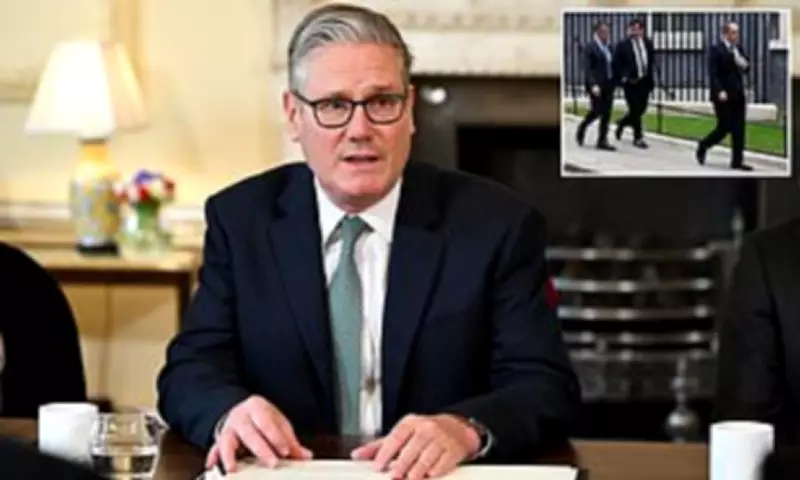
Prime Minister Keir Starmer has issued a stark warning to leading technology companies, declaring he is "going to act" to safeguard young people on social media platforms. However, in a candid admission, the Labour leader confessed he has not yet finalised the precise measures or implementation timeline for this critical initiative.
Downing Street Summit with Tech Titans
Sir Keir convened an urgent meeting at Number 10 on Thursday morning, summoning senior executives from some of the world's most influential digital platforms. The high-level gathering included representatives from X, Snap, TikTok, Google, and Meta, the parent company of Instagram. The Prime Minister pressed these industry leaders to intensify their efforts in protecting children, as the Government actively considers introducing new regulatory restrictions.
A Direct Warning from the Prime Minister
Opening the discussions, Sir Keir delivered a blunt message to the assembled tech bosses: "Things can't go on like this, they must change because right now social media is putting our children at risk." He elaborated on his vision for a safer digital environment, stating, "In a world in which children are protected, even if that means access is restricted, that is preferable to a world where harm is the price of participation."

These talks occur midway through Labour's ongoing public consultation on enhancing online child protection. Potential policy options under consideration mirror approaches seen internationally, including:
- An Australian-style social media ban for users under 16 years old.
- Strict limits on addictive platform features designed to maximise engagement.
- Stronger regulatory controls governing AI-powered chatbots and other automated systems.
Action Promised, But Specifics Pending
Speaking later to LBC radio, the Prime Minister was emphatic about his government's intent: "It is not a question of whether there's going to be something done, we are going to act." Yet, he immediately acknowledged the unresolved details, adding, "The question now is what exactly is that and what is the timescale around it."
Sir Keir refrained from committing to action by the summer but highlighted that the Government has already secured parliamentary powers to enable swift implementation once decisions are made. "We took powers earlier in Parliament to make sure we can act very quickly," he explained. "So this won't be like the Online Safety Act which took years - this is going to be much quicker than that. We're not a Government that is going to sit back here, we're going to act... this has to be done and it has to be done swiftly."
Personal Experience Informs Policy
The Prime Minister drew upon his own family life, revealing he previously imposed limits on his children's social media usage. "So far as any parent, all of us are worried about social media," Sir Keir shared. "My children are slightly older now. My boy is nearly 18, my girl is 15... when they were younger we had limits on how long they could be on, etc, the same sort of discussions as many parents will be having."
He stressed, however, that the issue transcends individual parental responsibility. "But this isn't about what individual parents are doing. I think most parents are saying, we want help. Most parents are saying, we are concerned about this, please put a framework around it. And that's why I say we are going to act here."
High-Profile Attendees and Parliamentary Context
The Downing Street meeting featured prominent figures from the tech world, including Wifredo Fernandez, X's Director of Global Government Affairs, and Alistair Law, TikTok's Director of Public Policy and Government Affairs for Northern Europe. They were joined by Markus Reinisch, Meta's Vice President for Public Policy in Europe, and Kate Alessi, Vice President and Managing Director of Google UK and Ireland.
Sir Keir's pledge for decisive action comes despite Parliament repeatedly rejecting calls for a blanket ban on children accessing social media. The ongoing legislative process, particularly concerning the Children's Wellbeing and Schools Bill, is set to grant ministers a flexible statutory power. This would allow the Government to impose various restrictions, such as:

- Night-time curfews for social media use.
- Daily limits on scrolling time.
- Restrictions on location-sharing features.
- The potential to block under-16s from specific platforms entirely.
A formal consultation, scheduled to conclude next month, has been established to guide ministerial decisions on the final course of action.
Legislative Tussle in Parliament
The House of Lords initially supported an amendment by Tory former minister Lord Nash, proposing a default ban on children using platforms deemed harmful, with a 12-month implementation window. However, the House of Commons has now twice voted against this specific measure during the legislative "ping pong" between chambers. Instead, MPs have endorsed the Government's preferred model of a flexible regulatory power.
In the most recent vote on Wednesday night, MPs sided with the Government by a majority of 106, with 256 votes to 150. Education Minister Olivia Bailey defended the approach in the Commons, arguing, "Instead of the narrow amendment proposed in the House of Lords, our consultation allows us to address a much wider range of services and features." She assured Parliament the Government would not pursue "endless rounds of consultation."
Nevertheless, Conservative Shadow Education Secretary Laura Trott vowed to maintain pressure, declaring, "I will keep fighting until the Government offers a ban on social media on the face of the Bill." This political divergence underscores the complex challenge facing the Prime Minister as he seeks to translate his promise of action into concrete, effective policy.