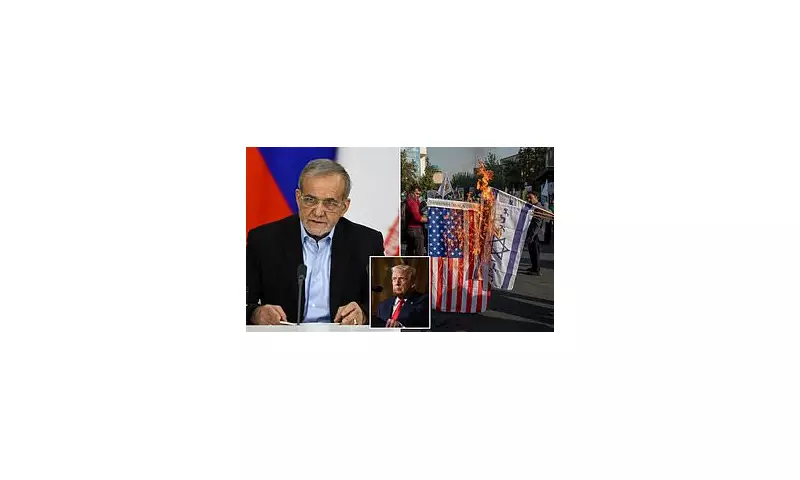
Iranian President Masoud Pezeshkian has issued a stark declaration of 'total war' against the United States, Israel, and Europe, framing the confrontation as an existential struggle for the Islamic Republic. The provocative statement was made during an interview with state-controlled media on Saturday, as Iran pushes to reconstitute its nuclear weapons programme following targeted American military strikes.
A Chilling Proclamation and Historical Parallels
In his remarks, President Pezeshkian left little room for ambiguity regarding Tehran's stance. 'In my opinion, we are at total war with the United States, Israel and Europe,' he asserted. 'They want to bring our country to its knees.' He drew a dire comparison to Iran's bloody conflict with Iraq in the 1980s, suggesting the current confrontation is even more perilous.
'This war is worse than the one launched against us by Iraq,' Pezeshkian stated. 'On closer inspection, it is far more complex and difficult. During the war with Iraq, the situation was clear: they fired missiles, and we knew exactly where we were responding. But now, we are being surrounded from every angle.'

Nuclear Ambitions and Defiance After US Strikes
The president's hardline rhetoric comes at a critical juncture. The United Nations recently imposed fresh sanctions on Iran over its persistent pursuit of nuclear weapons. This follows historic strikes ordered by President Donald Trump in June, which targeted Iranian nuclear facilities. While military analysts confirmed the attacks significantly degraded Iran's capabilities, they did not obliterate the programme entirely.
Pezeshkian openly dismissed the impact of the US strikes, boasting of a rapid military recovery. 'Our beloved military forces are doing their jobs with strength and now, in terms of equipment and manpower, despite all the problems we have, they are stronger than when they attacked,' he claimed. 'So if they want to attack, they will naturally face a more decisive response.'
Domestic Pressure and Shadowy Alliances
The Iranian leader's bellicose foreign policy stance contrasts with his recent admission of helplessness over Iran's crippled domestic economy. Facing scrutiny after telling university students he was 'powerless' to fix the economy, Pezeshkian attempted to recalibrate his message in the same interview, stating, 'I have said many times that I cannot do it, but that we can.'
Simultaneously, Iran's global alliances are drawing it into wider conflicts. A 'shadow fleet' of illicit tankers linked to Iran, Russia, and Venezuela has been detected operating alarmingly close to the US coastline in the Caribbean. According to research from United Against Nuclear Iran (UANI), revenues from this network fund terrorism via the Islamic Revolutionary Guard Corps and prop up hostile regimes, presenting a flashpoint for further escalation.
Jemima Shelley, a Senior Research Analyst at UANI, warned, 'Iran is the largest state sponsor of terrorism and its illicit oil sales are the main source of funding for its global terrorist activities.' She added that these funds are used to 'revamp its nuclear weapons and ballistic missile programme' and plot attacks on US soil.