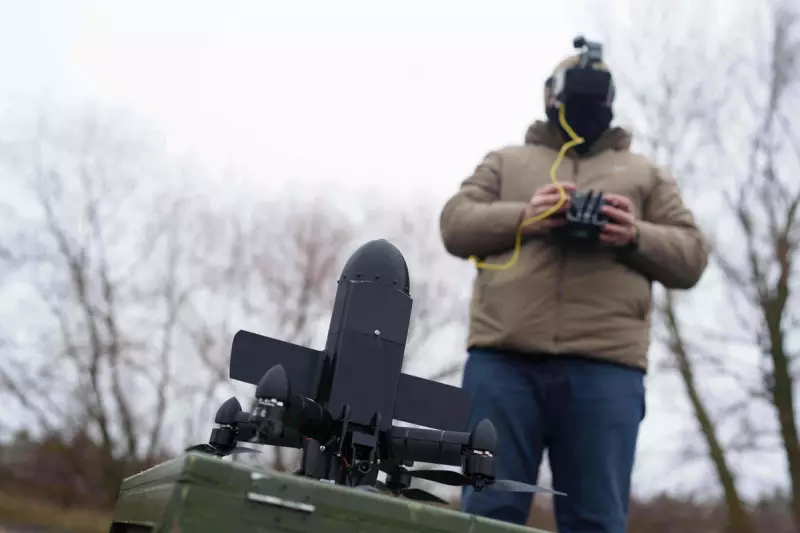
On the frozen Ukrainian front, a new breed of air defence is taking flight. Elite units are deploying innovative, low-cost interceptor drones, a rapid response to Russia's relentless nightly assaults on cities and critical power infrastructure.
The $1,000 Game-Changer
Faced with an evolving threat, Kyiv has been forced to rewrite its air defence doctrine. The solution has emerged not from vast state arsenals, but from agile, volunteer-driven startups. These groups have developed cut-price 'drone killers', with some models costing as little as $1,000 per unit.
Weapons like the Sting, shaped like a flying thermos and made by the startup Wild Hornets, and the newly fielded Bullet from General Cherry, represent this shift. They operate as first-person-view (FPV) drones, piloted by operators watching monitors or through goggles. Their mission is simple: surge at high speed and crash into incoming enemy drones.

The unit commander, known only by the call sign "Loi", emphasised the human impact. "Every destroyed target is something that did not hit our homes, our families, our power plants," he stated. "The enemy does not sleep, and neither do we."
Inflicting Economic and Tactical Damage
The economics of this new warfare are starkly in Ukraine's favour. Andrii Lavrenovych of General Cherry's strategic council highlighted the imbalance. The drones they destroy, primarily Iranian-designed Shahed suicide drones and their Russian variants, can cost between $10,000 and $300,000.
"We are inflicting serious economic damage," Lavrenovych said. He described a constant battle of innovation, where each side adapts. "In some areas they are one step ahead. In others, we invent an innovative solution, and they suffer from it."
Federico Borsari, a defence analyst at the Center for European Policy Analysis in Washington, confirmed the strategic value. "Cheap interceptor drones have become so important, and so quickly, that we can consider them a cornerstone of modern counter-unmanned aerial systems," he said. "They realign the cost and scale equation of air defence."
The Future: Automation and a European 'Drone Wall'
This hyper-scaling of drone production is expected to continue into 2026, influencing broader European security plans. NATO and Ukrainian defence planners are urgently working on a layered air-defence network along Europe's eastern borders, dubbed the "drone wall".
This system, to be rolled out over two years, is designed to detect, track, and intercept drones, with Ukrainian-style interceptors likely playing a central role. Furthermore, Ukrainian drone makers are set to expand co-production with U.S. and European firms next year, merging battle-tested designs with Western manufacturing scale.
Looking ahead, Lavrenovych points to increased automation as an inevitable trend. "Our mobile groups shouldn't have to approach the front line, where they become targets," he argued. "Drones must become fully autonomous robots with artificial intelligence — as scary as that may sound — to help our soldiers survive."
While Borsari cautions that these interceptors are not a "silver bullet" and depend on skilled operators and effective command systems, their deployment marks a pivotal moment. They have moved from prototype to mass production in mere months, offering a mobile, scalable, and economically devastating new layer in modern air defence.