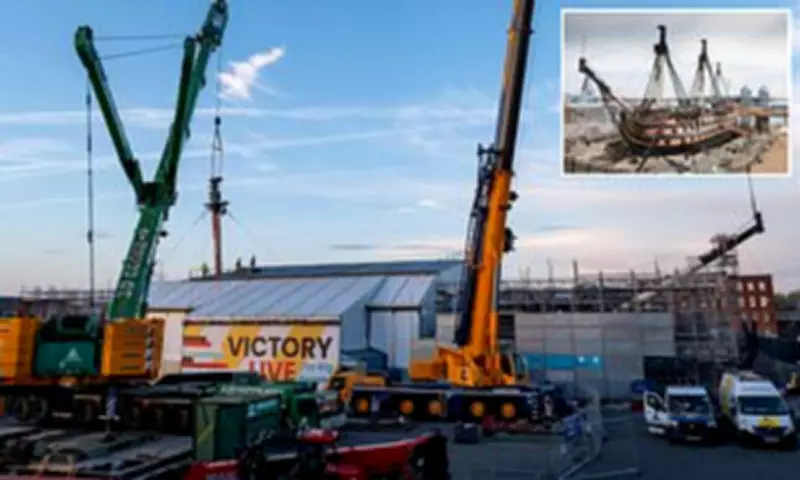
The removal of the masts from Vice-Admiral Lord Nelson's flagship HMS Victory has been hailed a 'great success' in the latest step to conserve the historic vessel. A 750-tonne crane was used to remove the 18th century warship's mizzen (rear), foremast (front) and bowsprit (the bow) as part of a £42 million restoration project.
They have now been safely lowered and laid near to the ship's side at Portsmouth Historic Dockyard, ready for careful conservation work to begin. Victory's front mast was removed on Monday and another two days of detailed work was needed to move the mizzen and bowsprit.
On Saturday, Patrizia Pierazzo, HMS Victory deputy project director, said: 'The removal of the mizzen mast and bowsprit was a great success and lessons learnt from the foremast removal earlier in the week really helped the team. This was a precise operation that required input from a wide range of specialists, and we're very pleased with the outcome.'

The main mast was removed in 2021. A scaffolding structure will now enclose the ship and remain in place until the conservation work is completed in 2033.
HMS Victory, which is the world's oldest commissioned warship, was Nelson's flagship at the Battle of Trafalgar and it was on the ship's quarterdeck that he was fatally shot by a French sniper on October 21, 1805. Victory was first floated out at Chatham in 1765 but by the 1920s was in poor condition and moved to dry dock in Portsmouth, Hampshire, in 1922.
Andrew Baines, executive director of museum operations for the National Museum of the Royal Navy (NMRN), previously described it as 'a key moment for The Big Repair project, being the first time Victory will have been without all her masts since the early 1890s'. He said: 'Our team has planned this step in meticulous detail but we still have to work around factors like the weather. That's why we will carry out the lifts overnight, so we can work safely and without interruption for several hours at a time.'
He added: 'The operation itself will be impressive with a 750-tonne crane rigged on site for a week. We have learned a huge amount from the removal of main lower mast in 2021 and once all masts are removed and safely stored, we can begin the critical work of conserving them before their eventual return to the ship in 2033.'
Stuart Sheldon, NMRN lead rigger, said: 'HMS Victory matters to people in a way few objects do. That brings real pressure and it should. This lift is complex and it needs absolute precision. Putting the plan into action on the night will be a career highlight for the whole team.'
HMS Victory and the wider Historic Dockyard site, which is also home to HMS Warrior and the wreckage of the Mary Rose, will remain open to visitors during the works.