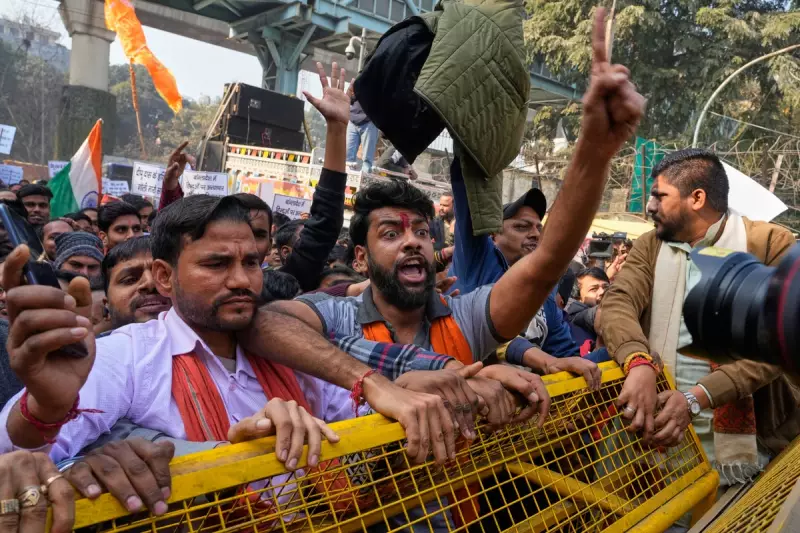
Hundreds of demonstrators gathered in the heart of India's capital on Tuesday, voicing fury over the brutal killing of a Hindu man in neighbouring Bangladesh. The protest, which saw tight security and minor scuffles, marks a significant new strain in the bilateral relationship between the two South Asian nations.
Violence Sparks Outrage and Protests
The catalyst for the New Delhi demonstration was the death of Dipu Chandra Das, a 25-year-old Hindu man. Das was publicly lynched and burned alive on Thursday in the Bhaluka subdistrict of Mymensingh, Bangladesh, following allegations of blasphemy. His killing occurred against a backdrop of heightened tensions in Dhaka, triggered by the death of Bangladeshi student leader Sharif Osman Hadi in a Singapore hospital. Hadi, a critic of India and former Prime Minister Sheikh Hasina, had been shot on December 12.
Protesters, largely mobilised by the Hindu nationalist group Vishva Hindu Parishad, assembled near the Bangladesh High Commission. They carried placards with slogans like "India will not tolerate torture of Hindus in Bangladesh" and chanted accusations that minority communities were being wrongly targeted. "People who are committing atrocities should stop doing that. We are here to awaken the people who are asleep," said one protester, Rajkumar Jindal, who warned of "dire consequences" if the violence did not cease.
Diplomatic Fallout and Reciprocal Summons
The incident has swiftly escalated into a diplomatic quarrel. In response to the lynching and subsequent violence targeting Indian diplomatic missions in Dhaka, New Delhi summoned Bangladesh's envoy this week. In a reciprocal move, Bangladesh's Ministry of Foreign Affairs summoned Indian High Commissioner Pranay Verma to express concerns over the security of its diplomatic posts in New Delhi, Kolkata, and Agartala.
International affairs expert Sreeram Sundar Chaulia of the Jindal School of International Affairs warned that the protest could complicate vital cooperation on trade, border management, and regional connectivity. "The rupture is a setback to India’s broader regional strategy," Chaulia stated, adding that Bangladesh's slowing economy could suffer from a loss of Indian development assistance, potentially pushing it closer to China.
A Fragile Relationship Under Pressure
The warm ties that flourished under the 15-year rule of Sheikh Hasina, who was considered a friend of India, have deteriorated since her ouster and exile in August 2024. Religious minority groups in Bangladesh have accused the interim government, led by Nobel laureate Muhammad Yunus, of failing to protect their safety—a charge the administration rejects.
Chaulia suggested that opposing India and alleging interference has become a tactic to justify a "blatantly Islamist and non-inclusive path" for Bangladesh. The killing of Dipu Chandra Das has intensified a pattern of fear within Bangladesh's Hindu community following Hasina's removal, threatening the stability once hailed as a rare example in the region.