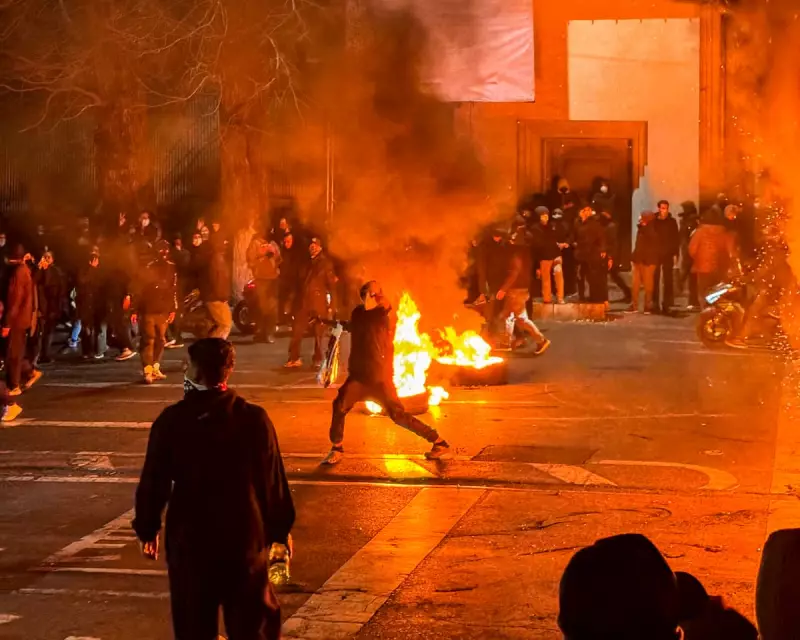
Iran is facing its most significant internal challenge in years as nationwide protests continue to be met with a severe and deadly crackdown by state security forces. At least 648 people have been killed and more than 10,600 arrested since the latest wave of unrest began, marking a profound hardening of public opinion against the Islamic Republic.
The Spark and the Crackdown
The demonstrations initially erupted on 28 December, reportedly started by electronics vendors in Tehran's historic bazaars before rapidly spreading across the country. While the government initially struck a conciliatory tone, this quickly evaporated. Shocking videos circulated of security forces storming hospitals to assault doctors and patients, further inflaming public anger.
In a drastic move to quell dissent and control the narrative, authorities shut down the internet and blocked international calls, effectively cutting Iran off from the outside world. The regime has since threatened protesters with death sentences, accusing them of acting on behalf of foreign powers like Israel and the United States.
A Crisis of Governance and Society
According to Dr Eskandar Sadeghi-Boroujerdi, a researcher of Middle East international politics at the University of St Andrews, the protests are the result of a "deep well of discontent." He points to a confluence of crises: a mismanaged water shortage, horrendous air pollution, and frequent electricity cuts due to crumbling infrastructure.
These are compounded by severe economic deterioration. Inflation is running above 40%, with food inflation surpassing 70%. The cost of essential staples has skyrocketed; bread, a crucial dietary item for the poor, has seen an inflation rate of 110%. However, Sadeghi-Boroujerdi emphasises that this is not merely an economic uprising but a profoundly political one, rooted in long-simmering anger over repression and a lack of civil rights.
A Regime Under Unprecedented Pressure
The researcher argues the Islamic Republic is weaker now than at any point in its 45-year history. A decade of compounding pressures, including crippling international sanctions, has not only weakened the state but "hollowed out Iranian society." This has entrenched a corrupt oligarchy while driving mass impoverishment, affecting even the once-stable middle class.
Regionally, Iran's strategy has unravelled. The costly intervention in Syria to prop up Bashar al-Assad ultimately backfired, and the aftermath of the Gaza war has left Tehran dangerously exposed. The regime is seen as "uniquely vulnerable," both internally brittle and regionally weakened, leading to its most isolated state since the 1979 revolution itself.
The international response has added to the pressure. Former US President Donald Trump has threatened "very strong" military action and warned of steep tariffs on any country trading with Iran. Meanwhile, the silence from Iran's own political establishment, including former presidents, is deafening, with none endorsing the state's claim that the unrest is purely a foreign plot.
What Comes Next?
The future remains deeply uncertain. While some protesters and members of the diaspora have rallied around exiled figures like Reza Pahlavi, the son of the last Shah, Sadeghi-Boroujerdi cautions this reflects desperation more than consensus. Iran, he notes, remains a politically diverse society with suppressed but persistent traditions of socialism, liberalism, and nationalism.
The ultimate authority still rests with Supreme Leader Ayatollah Ali Khamenei, and the ostensibly reformist President Masoud Pezeshkian holds limited power. The possibility of a internal deal to sideline hardliners exists but seems distant. For now, the regime is grappling with a fundamental crisis of governance, facing a population whose discontent appears to have reached a boiling point, with no clear path to resolution in sight.