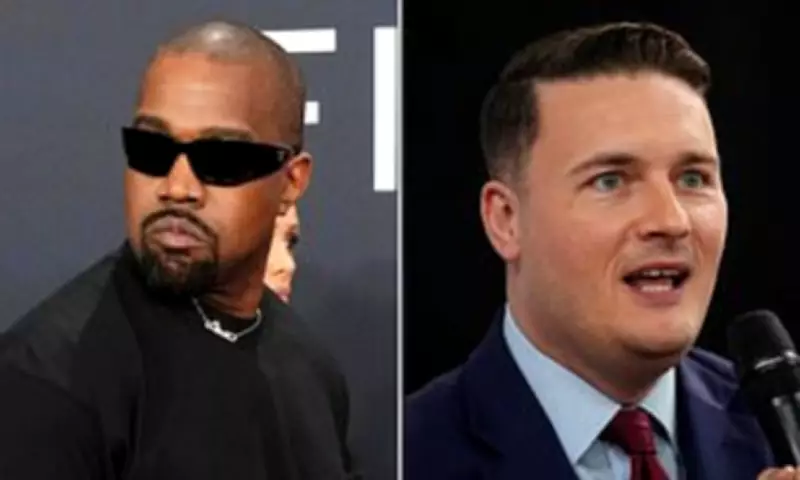
Kanye West Denied Entry to UK Over Antisemitism Controversy
The British government has formally blocked American rapper Kanye West from traveling to the United Kingdom following significant public and political backlash over his scheduled headline performance at Wireless Festival this summer. The decision comes after weeks of mounting pressure on authorities to prevent the controversial artist from entering the country due to his history of antisemitic messaging and Nazi glorification.
Visa Status Under Review
West, who had been granted a visa to perform at Finsbury Park in London in July, now faces exclusion after the Prime Minister's official spokesman confirmed that his permission to enter the UK was "under review." The spokesman stated that "all available options remain on the table" and emphasized that decisions are made "on a case-by-case basis in line with the law and the evidence available."
"Where individuals pose a threat to public safety or seek to spread extremism, the Government has not hesitated to act," the spokesman added, signaling the serious nature of the concerns surrounding West's potential visit.

Festival Organizer's Defense
Melvin Benn, managing director at Festival Republic which promotes Wireless Festival, revealed that West had received his visa "in the last few days" before the government's intervention. Benn, who described himself as a "deeply committed anti-fascist" and "person of forgiveness," defended the decision to include West in the lineup despite acknowledging the artist's past statements were "as abhorrent to me as it is to the Jewish community."
"We are not giving him a platform to extol opinion of whatever nature, only to perform the songs that are currently played on the radio stations in our country," Benn stated, arguing that West had a legal right to enter and perform in the UK.
Political and Community Opposition
Health Secretary Wes Streeting led political criticism of West's inclusion in the festival, stating unequivocally that the rapper should not be headlining Wireless. "I think his comments were absolutely grotesque," Streeting said, referencing West's release of a song titled "Heil Hitler" and his display of swastika imagery.
"With his enormous fame and reach comes influence and a responsibility, and his comments take place against a backdrop of rising antisemitism, rising hatred against Jewish people, not just around the world but in this country," Streeting added during an interview with GB News.
The Campaign Against Antisemitism (CAA) announced it would organize "a mass demonstration outside the festival" if West's performances proceeded as planned. The organization stated that "nobody knows what might come out of Mr West's mouth on that stage" and called festival organizers "ashamed of themselves" for booking the controversial artist.
West's Attempted Reconciliation
In response to the growing controversy, West published an updated version of his apology letter titled "To Those I've Hurt" that originally appeared as a full-page advertisement in The Washington Post in January. The rapper wrote that his "only goal is to come to London and present a show of change, bringing unity, peace, and love through my music."
West expressed a desire to "meet with members of the Jewish community in the UK in person, to listen" and acknowledged that "words aren't enough - I'll have to show change through my actions."
Jewish Community Response
Phil Rosenberg, president of the Board of Deputies of British Jews, responded critically to West's overtures, noting that "it has been less than a year since Kanye West released a song titled Heil Hitler, the culmination of three years of appalling antisemitism." Rosenberg highlighted that West's latest album still includes a track with the "abhorrent title Gas Chamber."
While expressing willingness to meet with West "as part of his journey of healing," Rosenberg stipulated that such a meeting could only occur "after he agrees not to play the Wireless Festival this year." The community leader emphasized that performing on the main stage at Wireless was not "the appropriate place to test this sincerity" without demonstrating "genuine remorse and change."

Legal Grounds for Exclusion
Home Secretary Shabana Mahmood possesses powers to exclude individuals from Britain if they are not considered "conducive to the public good." This authority extends to those who have "engaged in extremism or other unacceptable behaviour" or who might "incite public disorder" if admitted to the UK. Notably, a criminal conviction is not required for refusal on these grounds according to Home Office guidance.
Shadow Home Secretary Chris Philp had written to Mahmood urging her to use these powers to block West's entry, arguing that "at a time when antisemitism is rising in the UK, allowing someone with this track record to headline a major public event sends entirely the wrong message."
Sponsor Withdrawals and Broader Context
The controversy has already prompted several major sponsors to withdraw support from Wireless Festival. Pepsi, Diageo, Rockstar Energy, and PayPal have all pulled their sponsorship or promotional involvement following West's announcement as headline act. These corporate decisions reflect broader concerns about association with an artist whose behavior has drawn widespread condemnation.
The decision to block West's entry occurs against a backdrop of rising antisemitic incidents in the UK, including last month's arson attack on four Jewish community ambulances outside a north-west London synagogue. Three men have since been charged in connection with that suspected hate crime.
Prime Minister Keir Starmer joined criticism of the festival booking, calling it "deeply concerning" that West was due to perform "despite his previous anti-Semitic remarks and celebration of Nazism." The government's intervention represents a significant escalation in addressing concerns about West's potential impact on community relations during his planned UK visit.