Political tensions in Bangladesh have surged following a brutal daylight attack on a student leader, marking a dangerous escalation of violence ahead of the country's crucial parliamentary elections.
Daylight attack on student organiser
Muhammad Motaleb Sikdar, a central organiser for the labour wing of the National Citizen Party, was shot in the head by unidentified assailants on Monday. The attack occurred around 11.45am in the Sonadanga area of the southern city of Khulna.
According to Bangladeshi media, Sikdar was rushed to Khulna Medical College Hospital before being transferred to a private diagnostic centre for a CT scan. Doctors later reported that the bullet passed through one side of his ear and exited the other, leaving him out of immediate danger, though he remains under observation.

Saif Nawaz, an organiser with the party's Khulna metropolitan unit, confirmed that Sikdar was a divisional convener for Jatiya Sramik Shakti, the party's labour platform. He was reportedly involved in preparations for an upcoming labour rally when he was targeted. Local police in Sonadanga have confirmed an investigation is now underway.
Wave of unrest follows earlier assassination
This latest attack comes amid a wave of political violence triggered by the assassination of another youth leader just days earlier. Sharif Osman Hadi, a 32-year-old radical leader and spokesperson for the Inqilab Manch platform, was shot by masked gunmen in Dhaka on 12 December. Hadi, who rose to prominence during the 2024 uprising that ousted Sheikh Hasina's government, was campaigning for the upcoming election.
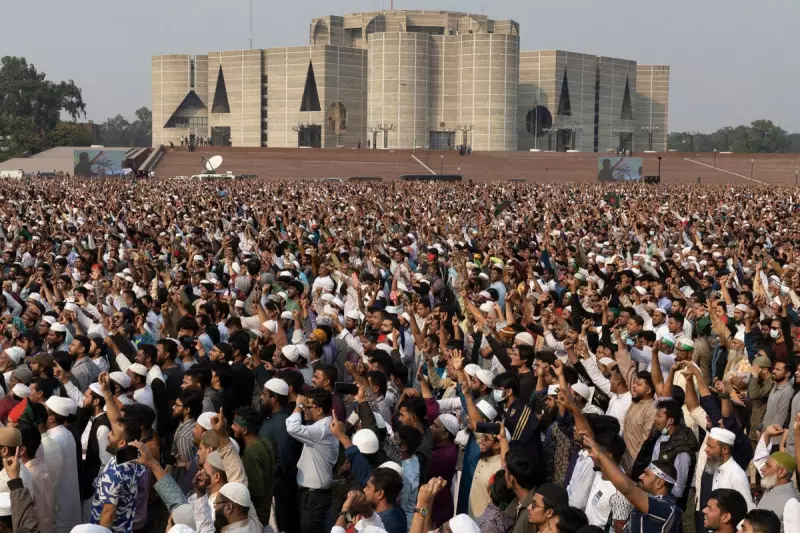
After initial treatment in the capital, Hadi was airlifted to Singapore, where he died on 18 December. His death sparked violent demonstrations across Bangladesh, with crowds setting fire to and vandalising buildings, including the offices of leading newspapers Prothom Alo and The Daily Star.
Protesters also targeted properties linked to Ms Hasina's Awami League party and attempted to march towards Indian diplomatic missions in Dhaka, Rajshahi, and Chattogram. Police responded with tear gas to disperse crowds in several locations.
The unrest turned sectarian in at least one confirmed incident, where a Hindu man, Dipu Chandra Das, was beaten to death by a mob in Mymensingh over alleged blasphemy.
Election tensions and international implications
Bangladesh's interim ruler, Muhammad Yunus, announced a day of national mourning following Hadi's death, and his funeral was held at Dhaka University. However, tensions remain critically high as the South Asian nation prepares for a parliamentary election scheduled for February.
The National Citizen Party, which emerged from last year's mass agitation, contains factions that have repeatedly issued anti-India statements. Following Hadi's shooting, a party leader, Hasnat Abdullah, publicly threatened to support forces hostile to Delhi, stating at a protest rally that the "Seven Sisters will be separated from India," a reference to India's seven northeastern states.
India has denied sheltering anyone responsible for Hadi's assassination. A statement from the Indian foreign ministry said, "We expect that the interim government of Bangladesh will take all necessary measures for ensuring internal law and order, including for the purpose of holding peaceful elections." Bangladeshi police stated they have no confirmed information on the whereabouts of Hadi's attackers and no evidence they have left the country.