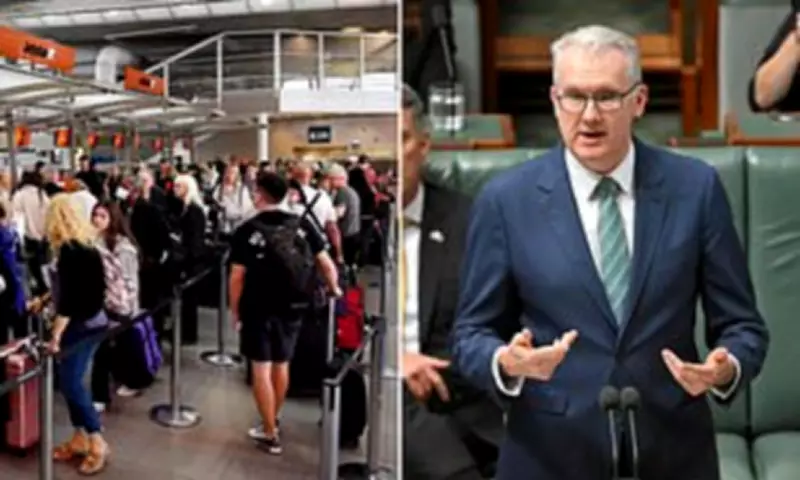
Australia has witnessed its third-highest February intake of overseas arrivals on record, with close to 100,000 individuals relocating to the country in a single month. Newly released data from the Australian Bureau of Statistics reveals that 96,110 net permanent and long-term arrivals touched down in February 2026, equating to approximately 3,432 people per day.
Historic Migration Figures
This figure represents the third-highest February intake in history, trailing only the previous year's 111,740 arrivals and the 105,460 recorded in February 2024. Over the twelve-month period leading up to February, net permanent and long-term arrivals soared to 478,910, hovering just below the record peaks of 498,270 in February 2024 and 494,540 in January 2026.
Total long-term and permanent arrivals are currently tracking near all-time highs, reaching 1.15 million for the year. While departures also experienced a significant surge, with 675,410 people leaving Australia on a long-term or permanent basis, this outflow was insufficient to counterbalance the substantial influx.

Government Response and Policy Context
Home Affairs Minister Tony Burke addressed the government's management of migration on Wednesday, defending their approach. He emphasised that net overseas migration figures encompass movements by Australian citizens returning from abroad, not solely new arrivals.
'One of the upward pressures on net overseas migration right now will be people who are expats in places like the United Arab Emirates who are making a decision, do they want to stay there or should they now come back,' Burke stated. 'Moments like that can cause people to have a decision to come back and sometimes that has a very significant impact on net overseas migration.'
Burke attributed the migration surge in previous years to pandemic-related distortions rather than new policy decisions. 'Be in no doubt that immigration numbers, when we first came to office, obviously got too high,' he admitted. He argued that the spike largely resulted from delayed departures following Covid-19 closures, rather than an increase in arrivals.
'Effectively you had a long period where you had very few people arriving. And then when people arrived disproportionately, people on three year visas, for example, all arrived at once,' Burke explained. He noted that the Labor government has since tightened visa settings, particularly for overseas students, and stressed that managing migration remains an ongoing challenge.
Economic and Housing Impacts
Economist Leith van Onselen warned that the migration wave is exacerbating housing pressures, especially for renters. 'Australia's long-suffering renters should be marching in the streets against the federal government,' he asserted.
Institute of Public Affairs senior fellow Dr Kevin You commented that the latest figures pour 'cold water' on the notion that the federal government has migration under control. 'Month-after-month, the overseas-born population of the country is rising in significant and unprecedented numbers,' he said. 'With the latest data showing almost a hundred thousand net permanent and long-term overseas arrivals to Australia in February alone, the need for reform to Australia's broken migration system could not be clearer or more urgent.'
Rental Market Squeeze Intensifies
Concurrently, Australia's rental crisis is worsening. Fresh data indicates that available properties have declined sharply, and vacancy rates have plummeted to perilously low levels across many regions.
SQM Research figures show the national residential vacancy rate dropped to just 1.0 percent in March, down from 1.1 percent in February. This represents nearly 3,000 fewer homes available, with only 31,732 rentals listed nationwide.
Conditions are particularly tight in all capital cities:

- Darwin and Hobart are the most constrained, each with vacancy rates of only 0.4 percent and fewer than 130 rental listings.
- Perth sits at 0.5 percent.
- Adelaide at 0.7 percent.
- Brisbane at 0.8 percent.
- Sydney and Canberra remain at 1.1 percent.
- Melbourne is the least pressured at 1.4 percent, though this figure has also deteriorated.
SQM Research described conditions in several cities as 'critically low,' cautioning that a persistent shortage of rental supply continues to drive up rent prices and fuel intense competition among tenants.