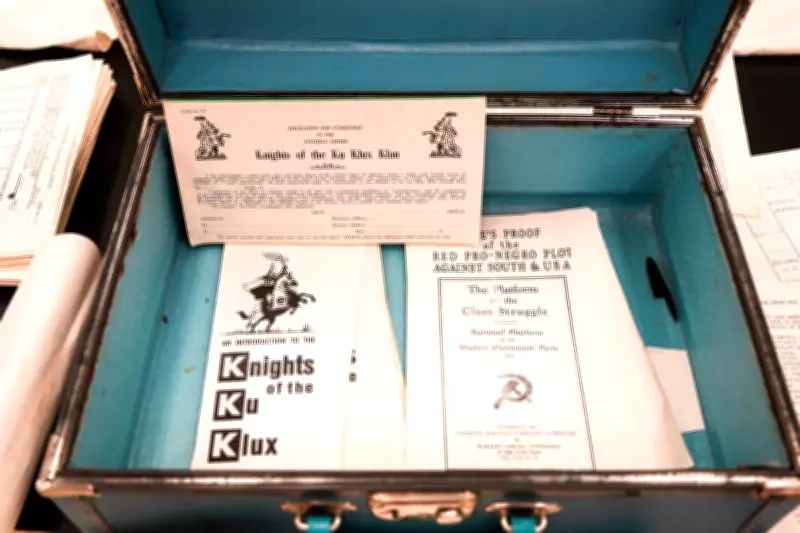
State officials in Mississippi have made a disturbing historical discovery during routine office preparations, uncovering full Ku Klux Klan regalia and propaganda materials while clearing out a closet at the Department of Public Safety. The find occurred as workers prepared to relocate to a new building, revealing a trove of materials that provides a chilling window into the state's past.
Historical Artifacts from the 1960s
According to a press release from the Mississippi Department of Archives and History, some of the uncovered materials date as far back as the 1960s. The collection includes not only the distinctive white robes and hoods associated with the KKK but also recruitment materials, detailed meeting notes, organizational ledgers, and various propaganda publications. All items were contained within a small blue suitcase that had apparently been stored and forgotten for decades.
Propaganda Targeting Civil Rights Leaders
Among the most significant discoveries was a propaganda pamphlet entitled The Ugly Truth about Martin Luther King, published by the United Klans of America. This document represents a direct attack on one of America's most revered civil rights leaders. Additionally, officials found a handbook published by the Knights of the Ku Klux Klan, providing insight into the organization's structure and operations during that turbulent era.

Connection to Freedom Rides
While examining the contents of the suitcase, officials made another important discovery: folders containing news clippings about the 1961 Freedom Rides. These historic protests saw demonstrators challenging segregation laws by taking interstate buses into the South. The clippings included references to T.B. Birdsong, the former head of the Department of Public Safety and Mississippi Highway Patrol.
According to a 1961 New York Times article referenced in the materials, Birdsong claimed during the Freedom Rides that the protests were "directed, inspired and planned by known Communists." This connection provides additional context about how state officials perceived and documented civil rights activism during that period.
Official Responses and Historical Preservation
Department of Public Safety Commissioner Sean Tindell addressed the discovery, noting that his department and the state's highway patrol troopers have worked for decades to "shed light on the darkness in which groups like the Ku Klux Klan chose to operate." He emphasized the importance of preserving such artifacts to ensure future generations understand this difficult history.
"By preserving these artifacts and shedding light on such organizations, we help ensure that future generations are never led astray by such hate," Tindell wrote in an official statement.
Barry White, the incoming director of the Mississippi Department of Archives and History, thanked Tindell for transferring the materials for archival preservation. "These records will give researchers broader access to documentation that deepens our understanding of Ku Klux Klan activities in Mississippi during the 1960s," White stated.
He added that receiving both administrative records and propaganda from a local chapter of a notoriously secretive national organization is particularly significant for historical research. The department estimates that processing and cataloging all the documents could take several months due to their historical sensitivity and volume.
Historical Context and Significance
The discovery provides tangible evidence of how deeply the Ku Klux Klan was embedded within certain aspects of Mississippi's institutional history during the civil rights era. The materials offer researchers unprecedented access to primary sources about Klan operations, propaganda techniques, and organizational structure during a pivotal period in American history.
While disturbing, such discoveries serve as important reminders of the nation's complex racial history and the ongoing importance of confronting difficult truths about the past. The preservation of these materials in a state archive ensures they will be available for scholarly study rather than remaining hidden or destroyed.