Fox News Host Laura Ingraham Criticises Democrats for Profanity While Defending Trump's Language
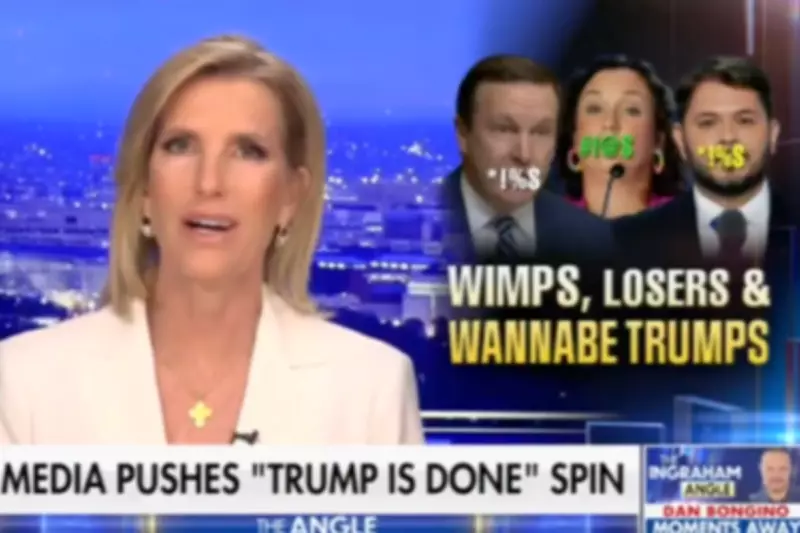
Fox News presenter Laura Ingraham has launched a scathing critique against Democratic politicians for their increasing use of profanity on social media platforms, while simultaneously offering a robust defence of former President Donald Trump's own expletive-laden outbursts. During her Thursday night broadcast of The Ingraham Angle, Ingraham mocked members of the opposing party for what she characterised as 'trying to be like Trump'.
Democrats' Social Media Language Under Scrutiny
Ingraham's commentary followed a detailed analysis published by The New York Times, which revealed a significant uptick in Democratic lawmakers employing the F-word in their social media communications. The six-year study demonstrated that Democratic politicians are substantially more likely than their Republican counterparts to utilise such language in public posts.
According to the investigation, last January alone witnessed 23 separate instances from twelve Democratic legislators where the F-bomb was deployed on the platform X. The most prolific user identified was Arizona Democratic Senator Ruben Gallego, who has employed the expletive an astonishing 77 times on X over the past six years. When approached for comment, Gallego's spokesperson declined to elaborate, stating they would 'just let his stats and history speak for itself'.

Notable Examples of Democratic Profanity
One particularly striking example highlighted by Ingraham involved California Governor Gavin Newsom's fiery exchange with Fox News host Sean Hannity on X during February. Newsom launched a profanity-laden retort after Hannity accused him of racism following comments the governor made about his SAT scores and dyslexia.
'You didn't give a s*** about the President of the United States of America posting an ape video of President Obama or calling African nations s***holes — but you're going to call me racist for talking about my lifelong struggle with dyslexia? Spare me your fake f***ing outrage, Sean,' Newsom responded vehemently.
Ingraham's Defence of Trump's Language
Despite her criticism of Democratic language, Ingraham offered a markedly different perspective when discussing former President Trump's own use of profanity. Trump made headlines with an explosive Easter Sunday post on Truth Social, where he employed graphic language to pressure Iran into reopening the strategically vital Strait of Hormuz.
'Tuesday will be Power Plant Day, and Bridge Day, all wrapped up in one, in Iran. There will be nothing like it!!! Open the F***in' Strait, you crazy bastards, or you'll be living in Hell - JUST WATCH!' Trump declared in the controversial message.
While acknowledging she 'didn't like' the post, Ingraham defended Trump's approach as strategically necessary. 'We now know the strategy behind that post. Simply put, the only way to get the attention of madmen is to sound like a madman,' she argued on her programme.
Broader Context and Political Implications
Ingraham posed a provocative question during her broadcast: 'If MAGA were truly on life support, why are so many Democrats trying to be like Trump?' This rhetorical inquiry underscores the perceived political calculation behind language choices in contemporary American politics.
The controversy extends beyond mere vocabulary, touching upon deeper questions about political communication, authenticity, and strategic messaging. Trump continued his aggressive rhetoric over the weekend, warning that 'all Hell will reign down' on Iran if they failed to comply with his demands. Although he subsequently announced a two-week ceasefire, he later criticised Iran's implementation as 'very poor job, dishonorable some would say'.
This episode highlights the ongoing debate about appropriate political discourse and the double standards that critics allege exist in media coverage of language from different sides of the political spectrum. As social media continues to reshape political communication, the use of profanity has emerged as a contentious flashpoint in America's cultural and political divisions.