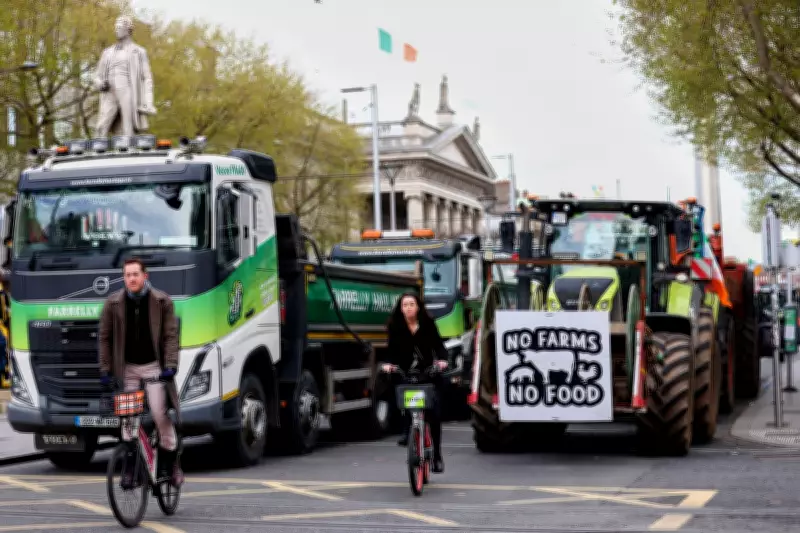
Ireland's coalition government is confronting a critical political challenge as it faces a potential no-confidence vote in Parliament on Tuesday. The motion stems from widespread dissatisfaction with the administration's handling of escalating fuel protests that have severely disrupted the nation's oil supply chain and created massive traffic congestion across key infrastructure points.
Political Showdown Over Fuel Crisis Management
The parliamentary showdown comes after a week of intensifying demonstrations that saw truckers, farmers, and transport operators block access to vital oil facilities and major ports. Prime Minister Micheál Martin's government announced new tax reduction measures in an attempt to defuse the crisis, but opposition parties have condemned what they describe as a delayed and inadequate response to the emergency situation.
Opposition Forces Mobilize Against Government
Sinn Féin, as the largest opposition party, has formally called for the no-confidence vote scheduled for Tuesday evening. However, in a strategic countermove, Martin's coalition government has arranged an earlier vote of support that could potentially render the no-confidence motion irrelevant if it passes successfully. The Social Democrats, Labour, People Before Profit, Aontu, The Green Party, and Independent Ireland have all declared their intention to support the no-confidence motion against the current administration.

The political stakes are exceptionally high, as passage of a no-confidence vote would compel the ruling government to resign. This would trigger either parliamentary proceedings to select a new prime minister capable of forming a government or potentially force a fresh general election, creating significant political uncertainty during an already volatile economic period.
Origins and Escalation of Fuel Protests
The protest movement began on April 7th with slow-moving convoys deliberately clogging roadways to draw attention to soaring fuel costs. The demonstrations gained momentum through social media coordination, eventually expanding to include blockades of critical infrastructure and Dublin's main thoroughfares. Protest organizers have consistently demanded either price caps or substantial tax reductions to alleviate what they describe as unsustainable fuel expenses that threaten to bankrupt businesses and households alike.
Government Response and Security Measures
Prime Minister Martin acknowledged that the government could learn from the protests while simultaneously defending the security response implemented by police and military personnel. Authorities cleared roadblocks at Whitegate, Ireland's sole oil refinery located in County Cork, and several distribution depots. These disruptions resulted in more than one-third of the nation's gasoline pumps running completely dry, creating widespread fuel shortages.
"We had no alternative but to clear Whitegate and the ports because approximately 90% of everything we manufacture in this country is exported," Martin explained. "The ports represent the absolute lifeblood of our economy. Had these blockades continued for any extended duration, we would have witnessed significant job losses, partial production shutdowns, and extremely serious economic consequences."
Violent Confrontations and Protest Outcomes
While demonstrations were initially tolerated, tensions escalated over the weekend when police deployed pepper spray during clashes with protesters. In a separate incident at Galway port, an army vehicle dismantled a log barricade erected by demonstrators. Despite these confrontations, many protesters expressed satisfaction that their actions had successfully pressured the government into making concessions and addressing their concerns.
Economic Relief Package Under Consideration
Lawmakers are also scheduled to vote Tuesday on a comprehensive fuel support package valued at 505 million euros (approximately $595 million). According to Prime Minister Martin, this assistance will help alleviate certain cost-of-living pressures affecting Irish citizens. The proposed package includes direct financial payments to truckers and school bus operators alongside fuel subsidies specifically targeted at agricultural and fishing industries. This relief measure follows a 250 million euro tax break approved just three weeks earlier.

Opposition Criticism of Government Actions
Sinn Féin has launched particularly harsh criticism against the Fianna Fáil and Fine Gael coalition government, accusing it of multiple failures. These include not adequately protecting citizens from dramatic fuel price increases, failing to recall Parliament during a holiday break to address the emerging crisis, and responding with what opposition leaders characterize as insufficient half-measures rather than comprehensive solutions.
The fuel crisis itself originated from broader geopolitical tensions, specifically following the U.S.-Israel military conflict with Iran that resulted in the closure of the Strait of Hormuz. This vital maritime channel typically handles a substantial portion of global oil shipments, and its closure created ripple effects that significantly impacted fuel availability and pricing in Ireland and numerous other nations.