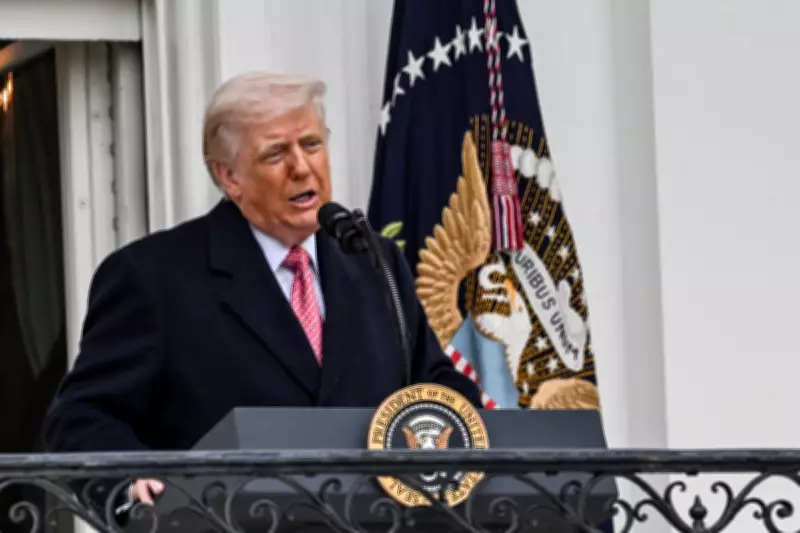
President Donald Trump welcomed a large group of American farmers to the White House on Friday, March 27, 2026, in an event he described as the largest such gathering ever held at the executive residence. The meeting came at a critical time, with farmers grappling with the fallout from Trump's tariff policies, soaring fuel costs, and potential fertilizer shortages exacerbated by an ongoing international conflict.
Trump's Mixed Messages on Farm Support
During his address from the Truman Balcony, Trump sought to reassure farmers that his administration was actively working to support the agricultural sector. He touted a series of policy initiatives, including the rescission of environmental regulations on water use, the implementation of tax cuts and deductions benefiting agricultural operators, and the virtual elimination of the estate tax—a long-standing Republican priority.
Trump claimed that American farmers had been "crushed" under the policies of his predecessor, Joe Biden, accusing the former president of crippling the industry with restrictive measures and failing to secure new trade deals. "Now the American farmers, ranchers, growers and producers, once again have a true friend and champion in the Oval Office," Trump declared.

Contradictions on Tariffs and Handouts
In a notable contradiction, Trump asserted that farmers "do not want handouts" and only desire a "level playing field." However, moments later, he boasted about providing $12 billion in farm relief, funded by revenues from tariffs he imposed—tariffs that have since been struck down by the Supreme Court. He described this as compensation for farmers being "unfairly hurt" by certain countries.
In reality, the $12 billion bailout program does not use tariff revenues. Instead, it draws funds from the Commodity Credit Corporation within the Department of Agriculture, which often borrows from the Treasury and private lenders. This initiative mirrors Trump's approach during his first term, when he distributed $28 billion in taxpayer-funded handouts to farmers affected by his tariff policies ahead of the 2020 election.
Attacks on Environmentalists and Technological Challenges
Trump's speech took a sharp turn as he discussed the increasing complexity of farm equipment, blaming environmentalists whom he labeled as "terrorists" for technological developments that complicate repairs. Paradoxically, he also promoted new renewable fuel standards that will allow more corn-based ethanol to be mixed into gasoline year-round, claiming these regulations would generate over $10 billion in rural economic benefits and create 100,000 jobs.
Additionally, he announced "massive new loan guarantees" for farmers through the Small Business Administration, aimed at helping them manage spiraling input costs resulting from his policies.
Divisive Remarks on Somalia and Minnesota Politics
The event took a contentious turn when Trump mentioned Minnesota, leading to an angry tangent about Governor Tim Walz, whom he called "crazy," and Attorney General Keith Ellison, whom he maligned as a "dirty cop." He then vowed that his administration would "take back" the state "from Somalia."
Trump made inflammatory remarks about Somalia, describing it as "the worst country in the world" and accusing Somali immigrants of stealing $19 billion. These comments added a layer of controversy to an event ostensibly focused on agricultural policy, highlighting the president's tendency to blend policy discussions with divisive rhetoric.
The gathering underscored the ongoing challenges faced by American farmers, who are caught between Trump's promotional efforts and the economic realities of his tariff policies. As fuel and fertilizer prices rise, the administration's reliance on taxpayer-funded subsidies and loan programs continues to be a point of contention, even as Trump positions himself as a champion of rural America.