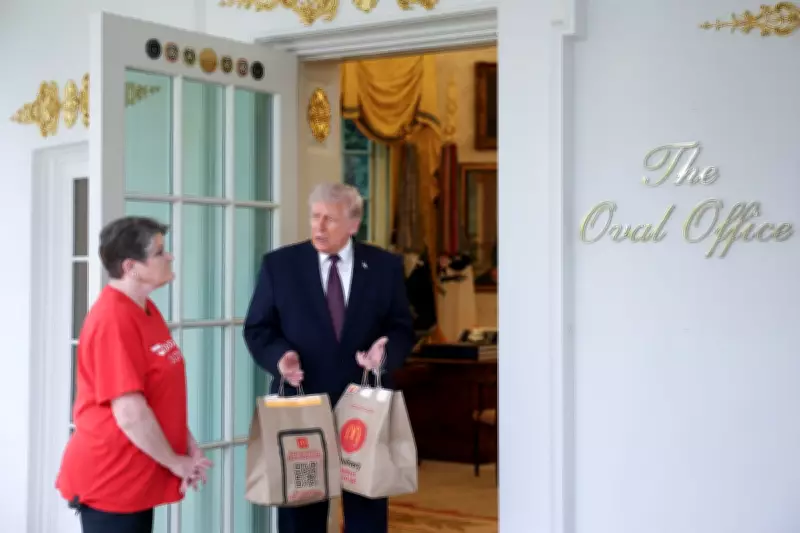
In a highly unusual and awkward public relations maneuver, former President Donald Trump orchestrated a DoorDash delivery of a McDonald's meal directly to the Oval Office on Monday, April 13, 2026. The event was staged as a promotional stunt for his administration's newly touted "no tax on tips" policy, which aims to benefit service industry workers like delivery drivers.
Unconventional Press Briefing Setup
The fast-food order arrived just before Trump was scheduled to speak with journalists about escalating tensions and military actions in the ongoing Iran war. Rather than conducting the briefing alone, Trump invited the DoorDash delivery employee, Sharon Simmons, to stand alongside him at the podium in the Oval Office.
Simmons, identified as a "Dasher" from Arkansas, remained present as Trump fielded questions from the press corps. The topics covered a broad range, including updates on the Iran conflict, relations with Cuba, commentary on Pope Leo, and strategic discussions about blockading the critical Strait of Hormuz.

Awkward Interactions and Political Ambiguity
The situation created several moments of palpable awkwardness. When a reporter directly asked Simmons if she had voted for Trump in the past, she responded with a non-committal "Maybe," offering no further clarification on her political leanings or voting history.
Later during the exchange, Trump himself prompted Simmons to comment on the contentious issue of transgender athletes in sports. She politely but firmly declined to engage with the topic, stating she had no comment to make on the matter despite the president's encouragement.
This entire episode represents one of the most bizarre intersections of fast-food culture, gig economy promotion, and high-stakes geopolitical discourse in recent political memory. The visual of a McDonald's delivery bag sitting on the Resolute Desk while the president discussed Middle Eastern military strategy with a DoorDash worker created surreal imagery that quickly circulated through media channels.
Administration officials defended the stunt as an effective way to highlight their proposed tax policy benefiting tipped workers, while critics denounced it as an inappropriate trivialization of serious foreign policy matters. The incident underscores the continuing unconventional approach to presidential communications and public relations that characterized Trump's previous tenure in office.