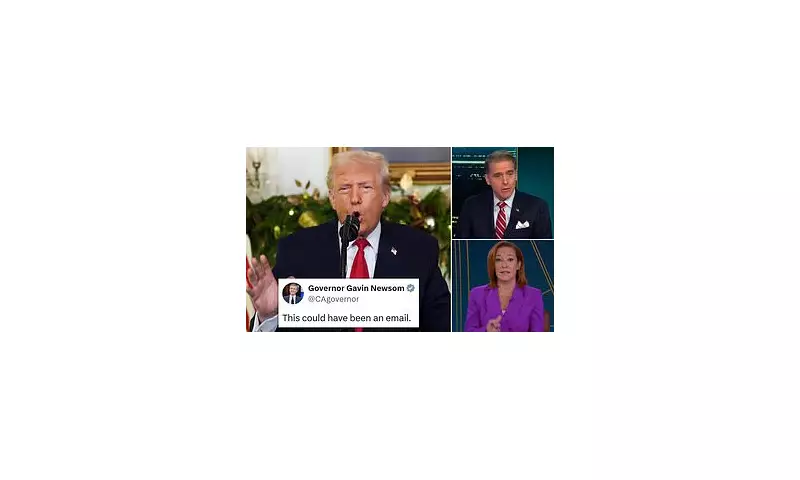
President Donald Trump's primetime year-end address, intended to defend his first eleven months back in office, has drawn sharp criticism from across the political spectrum. The 18-minute speech, delivered from the White House, saw the president blame his predecessor's administration for America's problems while announcing a special $1,776 'Warrior Dividend' for over a million active-duty soldiers.
A Sales Pitch Met With Scepticism
While Trump used the platform to proclaim that 'our country was dead' a year ago and is now 'the hottest country anywhere in the world,' the reception was mixed at best. CNN commentator and Trump supporter Scott Jennings labelled the president 'the salesman-in-chief,' suggesting fellow Republicans should rally behind him. However, many on the right joined left-wing critics in expressing bewilderment.
Pro-Trump pundit Michael Knowles suggested the president had manipulated media coverage, while others were less charitable. Conservative commentator Matt Walsh called it 'perhaps the most pointless primetime presidential address ever,' with Erick Erickson adding he was 'flummoxed.' Libertarian Billy Binion remarked that Trump 'says things that sound cool in his head regardless of whether or not they have any connection to reality.'

Democrats and Details: Scrutiny Over Claims
The most forceful rebuttal came from Democrats. Former White House Press Secretary Jen Psaki, on her MSNBC show, accused the speech of containing 'blatant falsehoods.' She specifically questioned the 'Warrior Dividend,' noting that Congress, not the president, controls federal spending. Psaki also cited an analysis estimating Trump's tariff policies have cost American households an average of $1,700 this year—a figure strikingly close to the $1,776 bonus promised to troops.
California Governor Gavin Newsom trolled the event on social media, writing 'This could have been an email.' Arizona Senator Ruben Gallego, a Democrat, expressed relief that Trump did not announce a war in Venezuela but questioned the speech's purpose.
Economic Promises Amidst Political Headwinds
Trump's core message was an economic one, despite recent data showing unemployment at a four-year high. He insisted his tariffs and tax cuts were turning the economy around and previewed what he called 'the largest tax refund season of all time' in the spring, stemming from his 'Big Beautiful Bill.' He used visual aids to claim his policies lowered prices for gas, cars, and food.
The speech came at a fractious time for the GOP, facing a difficult midterm election environment and internal divisions. It also followed a damaging leak about White House Chief of Staff Susie Wiles' private criticisms. Recent polls show Trump's approval rating at a low ebb, with an NPR/PBS News/Marist poll finding only 36% think he is doing a good job.
While Senator Lindsey Graham offered support, the address highlighted the challenges Trump faces in convincing a sceptical nation of his successes, as he gears up for the 2026 campaign trail to defend the Republican majority in Congress.