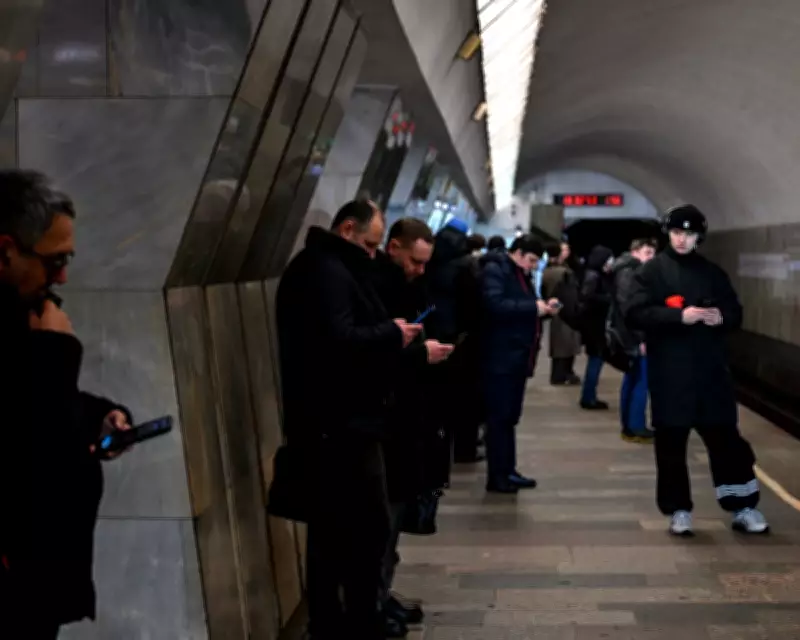
Kremlin Forces Big Firms into 'Witch-Hunt' Against Internet Rebels in Russia
Major Russian companies have been conscripted into a "witch-hunt" against users attempting to circumvent online controls, as the Kremlin continues its aggressive push to sever citizens from the global internet. According to a report by RKS Global, an advocacy group for internet freedoms, banks and web platforms are now collecting extensive data on individuals using virtual private networks (VPNs).
VPN Usage Under Intense Scrutiny
VPNs, which obscure a user's real location and allow access to sites blocked in Russia, have become a critical tool for tens of millions of Russians. This number surged dramatically following the full-scale invasion of Ukraine, after the Kremlin imposed sweeping bans on platforms like Facebook and Instagram. Authorities are now implementing far more rigorous measures to track these users, potentially exposing them to criminal penalties.
The investigation analysed 30 popular Russian apps, including those operated by T-Bank, Sberbank, the search engine Yandex, and the social media platform VKontakte. It revealed that 22 of these apps actively detect whether a user is on a VPN or has one installed on their phone. Most of these apps retain that data on their servers, where it can be accessed by security services.

"The level of intrusion into the device can be very high," stated RKS Global. "Any Android app released by Russian companies for the Russian market may now be spying."
Criminalisation and Surveillance Escalate
Mazay Banzaev, founder of the open-source VPN company Amnezia, highlighted the severity of the situation: "It's one thing if Russian IT companies were to 'catch' users the moment they visit a site with a VPN enabled. It is quite another when even a closed application continues scanning the phone for VPN usage."
For millions of Russians, this means their options to interact with the global community are narrowing, with interactions becoming increasingly fraught with risk. While using a VPN is not formally illegal in Russia, and businesses and state agencies still rely on them, activities surrounding VPN use are being progressively criminalised. This year, Russian courts have started treating VPN use as an aggravating factor in prosecutions.
Gradual Internet Throttling and Control
Over the past year, authorities have embarked on a gradual effort to throttle the global internet. This initiative began with mobile network blackouts across large swathes of the country last year, which later spread to major cities like Moscow and St Petersburg. As a result, Russians have resorted to purchasing paper maps and pagers to navigate and communicate.
Starting in March, authorities began blocking Telegram, a messaging app essential to daily life in Russia. The apparent goal is to push most Russians onto a government-controlled "superapp" called Max, which is believed to possess broad surveillance capabilities. This app has been aggressively promoted, leaving many with little choice but to install it.
A full-scale web shutdown, similar to the one employed by Iran, is more challenging for Russia due to its different internet infrastructure. Instead, the Kremlin has adopted a piecemeal and indirect approach to cutting off the population. For instance, widespread mobile restrictions in provincial areas have been justified as necessary to counter Ukrainian drones.
Transition to Active Censorship
This new regime of data gathering and app-mediated surveillance marks a significant transition from passive to active censorship, according to RKS Global. It means that little of Russians' private lives will remain out of reach of authorities. "Digital censorship in Russia is reaching a new level," the group concluded.
VKontakte, T-Bank, Sberbank, and Yandex were approached for comment but have not yet responded. The situation underscores the escalating digital repression faced by Russian citizens as the Kremlin tightens its grip on online freedoms.