Chinese Humanoid Robots Showcase Kung Fu Skills on National Television
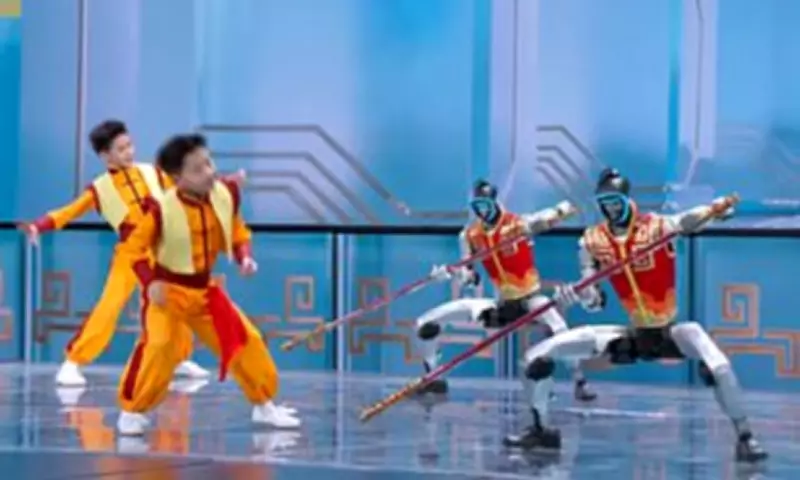
In a groundbreaking display of technological prowess, China's humanoid robots have unveiled a remarkable new ability: performing kung fu. The spectacle unfolded at the CCTV Spring Festival gala, the nation's most-watched television event, where dozens of Unitree G1 robots took to the stage. Clad in vibrant red vests, these machines executed a series of dynamic moves, including high kicks, flips, and intricate maneuvers with traditional weapons like nunchucks, swords, and poles.
What made the performance particularly astonishing was its proximity to human performers. The robots carried out their daring routines just metres away from young children, highlighting both the precision and safety of their operations. Footage released by Unitree has since gone viral, garnering widespread acclaim across social media platforms.
Social Media Reactions and Technological Innovations
Viewers expressed awe at the advancements, with one YouTube commenter noting, 'Five years ago, this would have been science fiction.' Another remarked, 'If I weren't watching directly from the Unitree Robotics channel, I'd say it was AI. Incredible!' The demonstration featured four leading humanoid robot startups—Unitree Robotics, Galbot, Noetix, and MagicLab—showcasing their products at the gala held in Beijing.

During Unitree's segment, the G1 robots, described as wearing the 'Monkey King's heavy armor,' performed a technically ambitious sequence that mimicked China's 'drunken boxing' martial arts style. This involved wobbly movements and backward falls, allowing Unitree to showcase innovations in multi-robot coordination and fault recovery, where robots can autonomously stand up after falling.
Unitree explained in a YouTube video description, 'Dozens of G1 robots achieved the world's first fully autonomous humanoid robot cluster Kung Fu performance (with quick movement), pushing motion limits and setting multiple world firsts!'
Specifications and Capabilities of the Unitree G1 Robot
The G1 humanoid robot is a marvel of engineering, weighing 35 kilograms (77 lbs) and standing 1.32 metres (4.33 ft) tall. It boasts 23 degrees of freedom in its joints, providing greater mobility than an average human. Behind its minimalist facade lies an advanced perception system equipped with a 3D LiDAR sensor and a depth-sensing camera, positioning it among the most sophisticated commercially available humanoid robots globally.
- Height: 4.3 ft (132 cm)
- Price: $16,000 / £12,000
- Weight: 35 kg
- Arm Span: 1.4 ft
- Speed: 2 m/s (5 mph)
- Power Supply: Lithium battery
- Manual Controller: Yes
Evolution from Previous Performances
This year's performance marks a significant leap from last year's gala, where 16 Unitree robots executed a simpler routine involving handkerchief twirling and dancing. Georg Stieler, Asia managing director and head of robotics and automation at technology consultancy Stieler, observed, 'It's been just one year – and the performance jump is striking.' He emphasized that the robots' motion control reflects Unitree's focus on developing AI-powered 'brains' for fine motor tasks applicable in real-world factory settings.
YouTube viewers echoed this sentiment, with one professional in robotics commenting, 'As a professional in robotics, I am again surprised by the advancement over last year.' Another added, 'Insaneeee, last year the robot is just spinning plates, and now they can do Kung Fu on live TV.'
Previous Viral Moments and Future Implications
Unitree's robots have previously captured public attention for their unconventional behaviors. Last year, the firm hosted the world's first humanoid robot boxing tournament, where two life-size robots exchanged punches and kicks in a ring under human supervision. While they demonstrated basic combat skills, challenges in accuracy and balance were evident.

This latest kung fu performance not only entertains but also underscores rapid progress in robotics, suggesting potential applications in industries like manufacturing and entertainment. As AI and robotics continue to evolve, such displays hint at a future where humanoid machines could become integral to daily life and work.