NASA's Curiosity Rover Uncovers Ancient Organic Molecules on Mars
NASA's Curiosity rover has made a groundbreaking discovery on Mars, detecting organic molecules that are widely regarded as chemical building blocks for the origin of life. This finding, which includes five previously unobserved compounds, was made in a dried lakebed near the planet's equator, offering new insights into the red planet's ancient past.
Preserved for Billions of Years
Scientists believe these organic molecules have been preserved on Mars for approximately 3.5 billion years. Professor Amy Williams, an astrogeologist at the University of Florida and a Curiosity mission scientist, led the experiment and stated, "We think we're looking at organic matter that's been preserved on Mars for 3.5bn years." However, she cautioned that the analysis cannot determine if these compounds are linked to ancient microbial life, delivered by meteorites, or formed through geological processes.
Harsh Conditions and Habitability
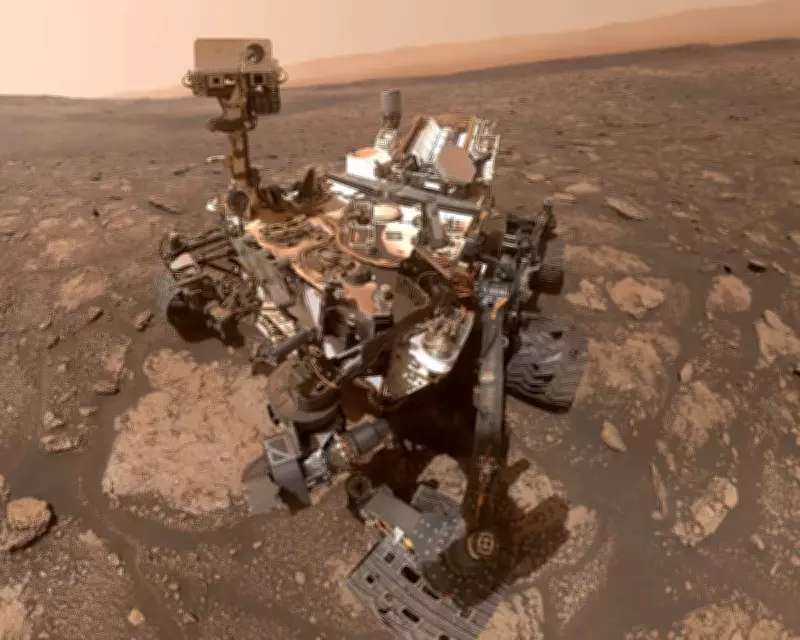
The car-sized Curiosity rover has been exploring the Gale crater and Mount Sharp since its arrival on Mars in 2012. Surface conditions are extreme, with temperatures plummeting below -100°C at night and intense solar radiation due to the lack of a protective atmosphere. Despite this, Mars once had liquid water and an atmosphere that could have supported life. Professor Andrew Coates, a planetary scientist at University College London's Mullard Space Science Laboratory, noted, "It had all the conditions for life to start there when life was starting on Earth. There's no known reason why it shouldn't have started on Mars as well."

Chemical Building Blocks
The rover's onboard instruments identified compounds such as benzothiophene, a sulphurous chemical often brought by meteorites, and hinted at nitrogen-bearing organic compounds similar to DNA precursors. Williams explained, "There are several steps between what we found and DNA. It is definitely a building block to how DNA is made now. But it is truly just the bricks, not the house." She added that similar molecules likely rained down on both Mars and Earth, potentially providing the foundation for life as we know it.
Future Missions and Implications
This discovery boosts hopes for the European Space Agency's Rosalind Franklin mission, scheduled to launch in 2028. That rover will drill up to 2 metres deep and conduct more sophisticated tests to assess the origin of organic compounds on Mars. The findings, published in the journal Nature Communications, suggest that if microbial life once existed on Mars, chemical fingerprints could still be present today, despite the harsh radiation environment that was previously thought to degrade all organic matter.