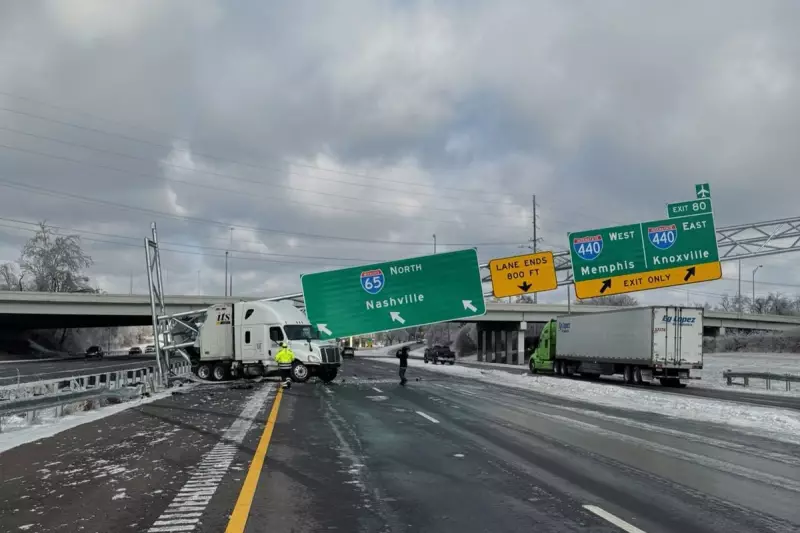
A devastating winter storm has plunged vast areas of the Southern and Northeastern United States into darkness and cold, leaving hundreds of thousands of residents without electricity as freezing temperatures continue to grip the region. The severe weather system, which brought crippling ice to the South and heavy snowfall to the Northeast, began to move out to sea on Monday, offering a glimmer of hope for recovery. However, for thousands of Americans, the immediate reality remains one of hardship, with no power or heat and forecasts predicting dangerously low temperatures overnight.
Widespread Power Outages and Emergency Conditions
According to data from poweroutage.com, more than 800,000 power outages were reported nationwide on Monday morning. The situation was particularly dire in Tennessee, where approximately 244,000 customers were without electricity by Monday afternoon. In the Nashville area alone, Nashville Electric Service reported 169,000 customers without power, while more than 150,000 outages were initially recorded in that region. Mississippi faced severe disruption as well, with about 160,000 customers still without power on Monday afternoon, down from an initial 140,000 in the hardest-hit areas. Louisiana also experienced significant impact, with 115,000 residents left in the dark by the icy conditions.
Personal Accounts of Devastation
Residents in affected areas described scenes of chaos and destruction. Adrian Ronca-Hohn, a 23-year-old football coach from Iuka, Mississippi, awoke on Monday to what he likened to "a war zone." He recounted a sleepless night filled with the sounds of falling trees and branches, stating, "We couldn’t go 10 seconds without hearing what sounded like a gunshot. You’d hear a pop, a hard pop, and you’d hear the whistle of it falling, and then it would crash to the ground and just kind of explode."

With temperatures across the South forecast to reach their lowest point early Tuesday morning, many without power are struggling to survive. Ronca-Hohn highlighted the vulnerability of mobile homes in the region, noting, "We have a lot of people without heat, without power and without water. We have a lot of mobile homes down here that aren’t very well-insulated."
By the Numbers: The Storm's Impact
The storm's severity is underscored by a series of stark statistics that illustrate its widespread effects:

- 1 inch of ice (2.5 centimeters) was recorded in multiple communities across Mississippi, Louisiana, Oklahoma, Alabama, and South Carolina.
- 1°F (minus 17°C) is the temperature expected early Tuesday morning in Nashville, Tennessee, where thousands remain without power.
- 6.7 inches of sleet (17 centimeters) fell at Clinton National Airport in Little Rock, Arkansas, according to preliminary totals.
- 10 days could be required to restore power in Allen County, Kentucky, as estimated by city officials, with similar timeframes projected in other communities. In New Albany, Mississippi, utility providers warned that full restoration might take "a minimum of a week and possibly more depending on conditions."
- 22.2 inches of snow (56.4 centimeters) accumulated in Sterling, Massachusetts, a preliminary figure through Monday morning.
- 47 locations in Nashville have been designated as warming centres, including fire and police stations, where residents can seek refuge and charge electronic devices.
- 50°F (10°C) was the temperature inside Marshall Ramsey’s home in Oxford, Mississippi, on Monday morning after he lost power. Ramsey, a longtime editorial cartoonist and university teacher, described the weekend ice storm as "like a demonic symphony of trees breaking, transformers blowing and thunder."
- 200-plus dogs were rescued from a rural property in the Tupelo, Mississippi, area just before the ice storm by Paws of War, a New York-based nonprofit that places animals with veterans and first responders.
Ongoing Challenges and Community Response
As the storm subsides, the focus shifts to recovery efforts, but significant challenges remain. The combination of extensive infrastructure damage and persistently low temperatures complicates restoration work. Emergency services and community organisations are mobilising to provide support, with warming centres offering critical relief in cities like Nashville. However, the scale of the outages means that some residents may face prolonged periods without essential services, heightening risks in an already precarious situation.
The storm's impact extends beyond immediate power loss, affecting daily life, safety, and local economies. With forecasts indicating continued cold weather, authorities urge affected residents to take precautions and seek assistance where available. The collaborative response from utility companies, emergency teams, and volunteers will be crucial in mitigating the storm's aftermath and restoring normalcy to the hardest-hit regions.