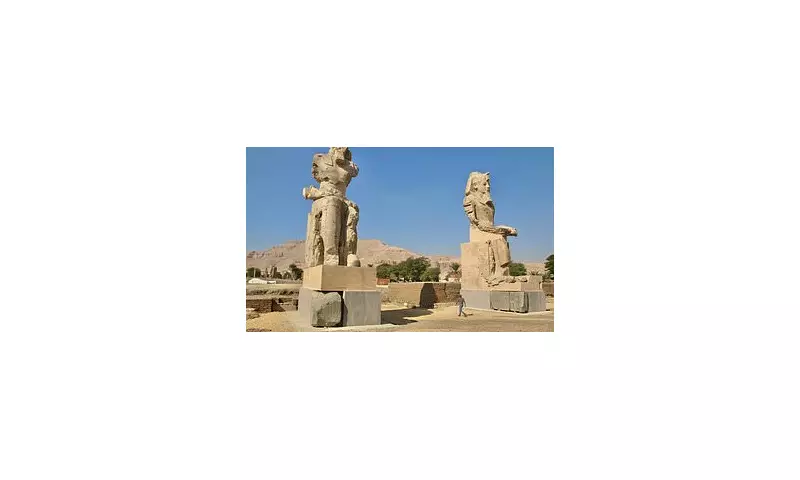
In a landmark moment for archaeology and cultural heritage, Egypt has officially unveiled the magnificent restoration of the Colossi of Memnon, two monumental statues that have stood guard on the west bank of the Nile for over 3,400 years. The project, spanning approximately two decades, has successfully repaired damage inflicted by a powerful earthquake around 1200 BC, returning the giants to their former glory.
A Monumental Restoration Effort
The grand reveal took place on Sunday, with authorities describing the twin statues as one of the most important landmarks of Egyptian civilisation. The colossi, each standing nearly 50 feet tall, represent the powerful Pharaoh Amenhotep III, who ruled from 1391 to 1353 BC during the New Kingdom's peak. The painstaking work involved reassembling fragmented pieces, some of which had been quarried away or reused in other ancient structures like the Karnak temple, and raising them back to their original positions.
An Egyptian-German mission, led by German Egyptologist Hourig Sourouzian, began the colossal task in the late 1990s. As Mohamed Ismail, Secretary-General of the Supreme Council of Antiquities, explained, the project aims to revive how this funerary temple of king Amenhotep III looked like a long time ago. The statues were originally constructed in 1350 BC from quartzite sandstone blocks, quarried near modern-day Cairo and transported an astonishing 420 miles to their site opposite Luxor.

The Legacy of a God-King
Amenhotep III, grandfather of the famous Tutankhamun, presided over ancient Egypt at its zenith. Archaeologist Michael Habicht of Flinders University notes the pharaoh promoted peace and lived in a time of the greatest economic prosperity. His wealth was legendary; foreign rulers reportedly begged for Egyptian gold, claiming it was abundant in Egypt as sand. Dr. Habicht suggests Amenhotep III may have been one of the richest men that ever lived in his epoch.
The reign was also marked by immense construction projects and a taste for luxury. The pharaoh, worshipped as a living god, is thought to have imported hundreds of foreign women for his harem. His architectural legacy includes the mortuary temple where the colossi stand and the Soleb temple in Nubia. The statues themselves are unique, partly compiled from separately sculpted pieces fixed into a main monolithic alabaster core.
Symbolism and Significance
Seated with hands on their thighs, the colossi gaze eastward towards the Nile and the rising sun. They are adorned with the striped nemes headdress, topped by the double crown of Upper and Lower Egypt, and wear a pleated royal kilt, symbols of divine rule. Smaller statues of his wife, Queen Tiye, are carved at his feet, and the surfaces are covered with over 100 Greek and Latin inscriptions added by later visitors.
For Luxor—one of the world's oldest continuously inhabited cities—the restoration is of profound significance. The city, a global hub for ancient temples and antiquities, now sees one of its most iconic monuments fully resurrected. This achievement not only safeguards a priceless piece of human history but also revitalises a direct link to the age of a pharaoh whose economic and cultural influence shaped the ancient world.