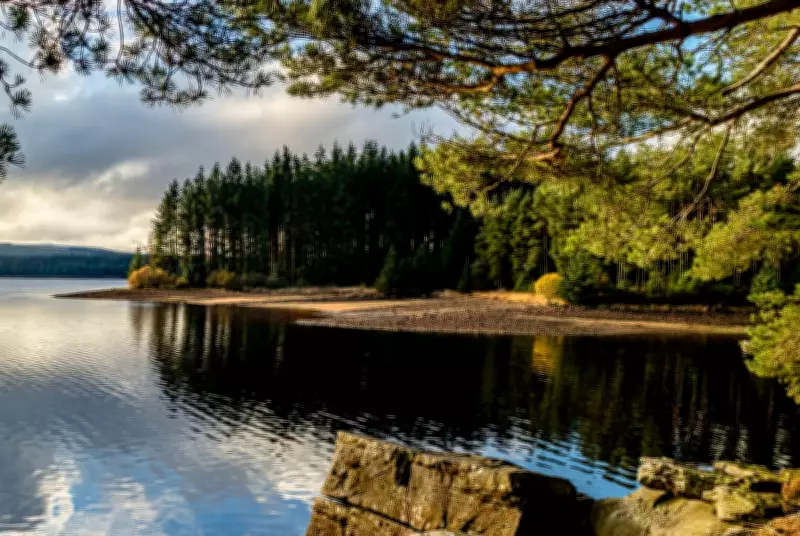
Kielder Water stands as one of Europe's largest man-made lakes, a monumental feat of engineering set within the breathtaking landscapes of Northumberland. This year, the surrounding Kielder Forest marks its centenary, celebrating a century of growth, conservation, and carefully managed tourism with new trails and events under England's darkest skies.
A Forest Unlike Any Other in England
Deep within Kielder Forest, on the northern shore of the vast Kielder Water, stands Silvas Capitalis—a giant, two-storey timber head that ranks among the most striking of the twenty sculptures hidden among the pines. Its mouth hangs agape, as if perpetually astonished by the surrounding wilderness. For first-time visitors, this expression of awe becomes familiar; the sheer scale of the landscape unfolding around Kielder Water and forest is genuinely staggering.
Kielder does not resemble the typical English countryside. Spanning 250 square miles (648 square kilometres) and home to 158 million trees, predominantly sitka spruce conifers planted by hand, it feels more akin to the vast woodlands of Finland or Canada. Despite being a plantation forest, it exudes a raw, untamed wilderness atmosphere. As a working forest, it supports 500 full-time jobs, excluding tourism, and 2026 commemorates the centenary of the initial plantings, initiated when Britain urgently needed timber reserves following the First World War.

Historical Roots and Visionary Beginnings
The desolate moorland surrounding Kielder Castle was identified as an ideal site for a new forest by Roy Robinson, a key figure in establishing the Forestry Commission in 1919. "He was a visionary," remarks Alex MacLennan, a member of the Kielder team for over two decades. "This was challenging farming terrain, yet perfect for forestry. Originally, eight villages were planned to house timber workers. However, three decades later, when the first trees matured for felling, mechanisation and innovations like chainsaws reduced the requirement to just three villages."
Consequently, development within the forest remains minimal. The primary tourist hub is Kielder Waterside, where fifty unobtrusive lodges nestle among the trees. Some of these structures sustained damage five years ago when Storm Arwen devastated the area, felling a million trees across the forest and the broader Northumberland National Park. "It has altered the forest's character significantly," notes Gary Storey, General Manager of Waterside, "providing an opportunity to replant with UK-native species such as silver birch, oak, aspen, and wild cherry, diversifying beyond the sitka spruce."
Benchmark for Sustainable Forestry and Tourism
Kielder's meticulous management has established it as a benchmark for forestry in the UK, particularly for its low-impact tourism integration. Beyond Kielder Waterside, accommodation options include Calvert Kielder, which offers self-catering lodges and specialises in respite care breaks filled with accessible, forest-based activities. Remote spots with facilities allow camper vans to park for £15 per night, alongside a campsite with two-person pitches at £20.
"We are not Center Parcs, and we never will be," asserts Liz Blair, Director of the Kielder Partnership, during a conversation over coffee. "However, we are committed to ensuring Kielder is accessible and welcoming for everyone, regardless of how they choose to enjoy it."
Immersive Experiences: Lakeside Way and Dark Skies
Many visitors, including myself, embark on the Lakeside Way—a 26-mile (42-kilometre) route encircling Kielder Water, connecting sculptural installations and immersing walkers and cyclists in the dense forest. During my visit, the silence between the trees felt almost tangible, interrupted only by the occasional rat-a-tat of a woodpecker calling for a mate.
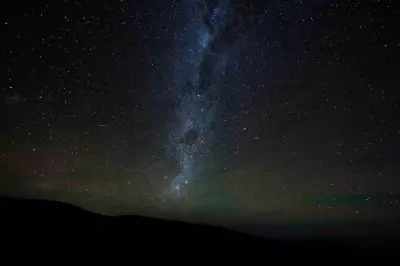
If Kielder is tranquil by day, it transforms into an almost otherworldly realm at night—a pitch-black void with minimal signs of life, save for the brilliant stars of England's first dark sky park, the Northumberland International Dark Sky Park. Driving up to the observatory, I was grateful for my sister Caroline's company, her continuous chatter a comforting contrast as the two-mile off-road path wound deeper into the silent forest.

We visited during the Northumberland Dark Skies Festival, attending a fascinating, albeit science-intensive, talk on exoplanets before braving the bitter cold to explore the telescope room. Although clouds obscured the view, the experience remained extraordinary, facilitated by a mix of professional astronomers and passionate volunteers.
Superlatives and Centenary Celebrations
Kielder is a land of superlatives: England's largest forest, the UK's biggest human-made lake by capacity, and the darkest skies, alongside arguably the most daunting mountain bike trails in the nation. The Deadwater Double Black Downhill officially opens on 1 May—a rock-strewn, ledge-filled, vertiginous route I would hesitate to walk, let alone cycle. This trail is among several new initiatives commemorating the centenary, including a Room on the Broom trail for children based on Julia Donaldson and Axel Scheffler's book, the Kielder Celebration Weekend from 4-6 September, and the summer reopening of Kielder Castle following extensive renovations.
Beyond the Forest: Northumberland's Untouched Beauty
The forest, though immense, constitutes just one segment of the Northumberland National Park—the least populated and least visited of the UK's fifteen national parks. For someone accustomed to the built-up south-east, the stark, untouched landscapes offer extraordinary beauty, a stillness and peace unmatched by locales nearer to home. The historical richness is equally impressive; we explored the ruined Roman fortress at Vindolanda, took a windswept stroll along Hadrian's Wall, and warmed up with a hearty lunch of Cumberland sausage, mustard-mash, and thick onion gravy at the centuries-old Twice Brewed Inn.
Yet, nothing quite compared to the late afternoon journey to the summit of Deadwater Fell in Alex's Forestry Commission van. Standing at the peak, 571 metres (1,900 feet) above sea level, the 360-degree vista seemed endless—from the Cheviot Hills in the north-east to the peaks of the western Lake District, with the snow-capped Pentland Hills rising towards Edinburgh like great white meringues. It was genuinely awe-inspiring. I was profoundly relieved not to have to mountain-bike back down.