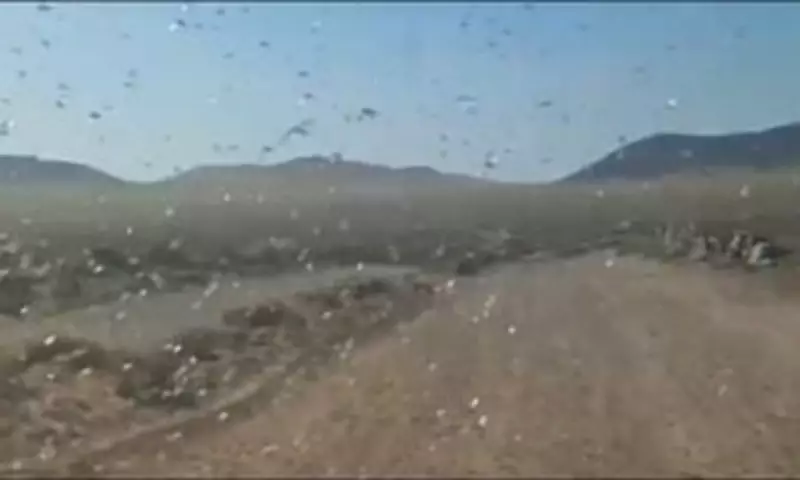
Locust Swarms Descend on Canary Islands: Officials Urge Calm in Four Holiday Hotspots
Authorities across four major Spanish holiday destinations have issued a firm 'stay calm' message after significant swarms of locusts descended upon the Canary Islands. The affected islands include the popular tourist hotspots of Lanzarote, Tenerife, Gran Canaria, and Fuerteventura. Officials are adamant that these giant insects pose no direct danger to the public but have issued warnings that they could threaten agricultural crops if their numbers surge into a full-blown plague, reminiscent of an incident two decades ago.
Social Media Footage and Insect Origins
Videos circulating widely on social media platforms vividly depict hundreds of locusts swirling through the picturesque countryside of the islands. The insects, scientifically known as Schistocerca gregaria and locally referred to as the Barbary cigarrón, are believed to have been blown in from Western Sahara. This migration follows recent periods of warm, wet weather conditions that facilitated their movement across the sea.
The locusts have been spotted across numerous areas of Lanzarote, including well-frequented tourist zones such as Arrecife, Costa Teguise, Famara, Uga, and Tahíche. Historically, this species has arrived from the African continent on easterly or south-easterly winds that carry Saharan dust, a pattern observed in previous decades.

Historical Context and Potential Threat
Two decades ago, a plague of these locusts wreaked substantial havoc on crops and disrupted daily life on the islands. At that time, firefighters were deployed in certain areas to tackle the severe infestation. According to the Food and Agriculture Organisation of the United Nations, this species is recognized as the world's most destructive migratory pest. Under specific environmental conditions, it can form dense, fast-moving swarms capable of causing significant agricultural damage.
The locust possesses a remarkable capacity to destroy crops, as it ingests its own body weight in food daily. To illustrate, a single swarm covering one square kilometre can contain up to 80 million adult individuals. Such a swarm has the capacity to consume the same amount of food per day as 35,000 people, which has historically made it a key accelerant in famines across Africa and the Middle East.
Current Response and Monitoring
The government of Lanzarote has already mobilised its environmental services, which will maintain a state of high vigilance over the next 48 hours. Island leaders express confidence that the current swarms will not escalate into a full-scale plague. Francisco Fabelo, the head of the Environment of the Cabildo, emphasised the critical nature of the coming days.
'The next two days are going to be key. If they are adult specimens that have arrived exhausted, they will die and nothing will happen. If we see copulations, that would mean that they are reproducing. We would have to see it between this afternoon and tomorrow,' Fabelo stated. He added, 'We already experienced this in 2004 and at the end of the eighties there was another similar episode. On both occasions it was very striking, with specimens all over the roads but they did not cause damage inside.'
Historical Plagues and Agricultural Assurance
The Canary Islands experienced one of its most severe desert locust episodes in October 1958. During that event, large swarms originating from Africa devastated crops across the islands, particularly in the south of Tenerife, affecting municipalities such as Arico, Fasnia, Granadilla de Abona, and the Güímar Valley. Tomato and potato plantations suffered significant damage, prompting the mobilisation of planes from the Ministry of Agriculture to conduct aerial fumigation. Meanwhile, local residents and farmers attempted to combat the insects from the ground using rudimentary methods like bonfires, noise, and poisoned baits.

A similar episode had already occurred in 1954, when another swarm devastated more than 10,000 hectares of crops across the islands. Despite this troubling history, current agricultural leaders on the islands assert they do not fear a repeat scenario and have stressed that the islands now possess the necessary means to combat any potential problem effectively.
Theo Hernando, Secretary General of the Association of Farmers and Ranchers of the Canary Islands (Asaga), provided reassurance: 'It is common for episodes of winds from Africa, such as those brought by the haze, to have locust specimens. They are blown by the wind and as long as they are isolated cases there is no problem. They arrive very weakened, they are not in a position to settle or reproduce. Nature itself takes its course and many times they end up being preyed upon by birds.'