Emergency services in New Zealand are engaged in a desperate search for multiple missing individuals, including at least one child, following a catastrophic landslide that ripped through a popular holiday campsite at the base of Mount Maunganui. The disaster struck on Thursday morning after days of torrential rainfall linked to a tropical weather system, which has caused widespread flooding and chaos across the North Island.
Chaos and Collapse at Campsite
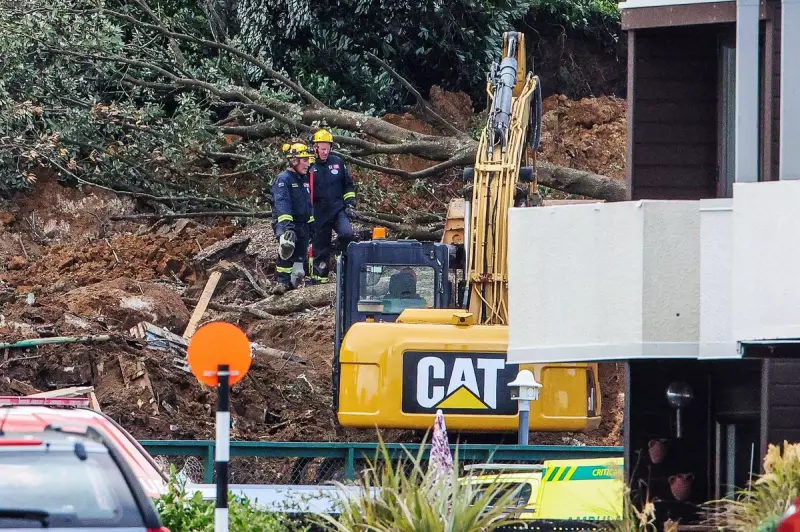
The landslide, which occurred at the Mount Maunganui campground, caused severe destruction, overturning campervans, crushing tents, and damaging a toilet and shower block. Rescue teams initially reported hearing voices calling for help from beneath the rubble shortly after their arrival. However, by late afternoon, no further signs of life had been detected, raising grave concerns for those trapped.
Authorities have been forced to withdraw personnel from the immediate site due to the ongoing instability of the hillside, fearing further movement could endanger rescue workers. Fire and Emergency New Zealand commander William Pike confirmed the difficult situation, stating that while initial signs of life were present, safety precautions necessitated a pullback.

Record-Breaking Rainfall and Widespread Impact
The Bay of Plenty region, where Mount Maunganui is situated, experienced its wettest day on record, with the nearby city of Tauranga receiving approximately 295mm of rain in just over thirty hours. This deluge represents roughly two and a half months' worth of typical rainfall, saturating the ground and triggering the landslide.
Local states of emergency have been declared across several regions, including Northland, Coromandel Peninsula, Tairāwhiti, Hauraki, and parts of the Bay of Plenty. Residents have been urged to evacuate low-lying areas and avoid all non-essential travel as the crisis continues to unfold.
Rescue Operations and National Response
Around forty firefighters, including specialised urban search and rescue teams and sniffer dogs, are working at the landslide site, which has been fully evacuated. Two excavators have been deployed to assist with the removal of debris and facilitate the search efforts. Police indicate that the number of people unaccounted for is believed to be in "single figures," though the exact count remains unclear as some campers may have left without notifying authorities.
New Zealand's Emergency Management Minister, Mark Mitchell, described parts of the east coast as resembling "a war zone," with helicopters deployed to rescue families trapped on rooftops. He emphasised the fluid and challenging nature of the situation, acknowledging the immense efforts of all emergency personnel involved.
Witness Accounts and Additional Incidents
Witnesses to the landslide described scenes of sheer terror and chaos. Sonny Worrall, an Australian tourist who was swimming in nearby hot pools, recounted narrowly avoiding being struck by a caravan. "I heard rolling thunder and cracking trees," he told local media. "The whole hillside gave way. It was the scariest thing I've ever felt in my life."
In a separate incident in Papamoa, south of Mount Maunganui, two people were reported missing and one person seriously injured after another landslide struck a home early on Thursday. Elsewhere on the North Island, police are searching for a 47-year-old man who was swept away with his vehicle while attempting to cross a river near Warkworth on Wednesday.
Broader Weather Crisis and Climate Context
The landslide is part of a broader weather emergency affecting New Zealand. Fire and Emergency New Zealand has responded to more than 230 weather-related callouts since Tuesday, including rescues from rooftops and flooded homes. In the east coast settlement of Punaruku, firefighters reported houses buried in mud, logging debris, and floodwater.
At least 8,000 households remained without power on Thursday, down from 16,000 earlier, while dozens of roads were closed due to flooding and further landslides. The National Emergency Management Agency has warned that additional heavy rain is expected, falling on already saturated ground and increasing the risk of more landslides, flooding, and dangerous river conditions.

Scientific Perspective on Extreme Weather
Climate scientists have noted that the pattern of increasingly intense rainfall is consistent with expectations in a warming climate. Professor James Renwick, a climate science expert at Victoria University of Wellington, commented, "It seems that these days, every storm brings with it orange or red flood warnings and devastation and misery somewhere in the country. Sadly, this is exactly what we expect with a warmer climate that has more moisture in the air."
Government and Community Reaction
Prime Minister Christopher Luxon stated that the government is doing everything possible to support affected communities and praised emergency crews for their relentless efforts. "All those who are putting themselves in harm's way to keep Kiwis safe, the whole country is grateful," he said.
Communities across the island have reported dramatic rescues, including neighbours pulling a 94-year-old man from floodwaters in Coromandel and a woman rescued by kayak as fast-flowing water rose to neck height around her home. The nation remains on high alert as the search for the missing continues and weather conditions persist.