Antarctic 'Pyramids' Ignite Theories of Lost Global Civilization
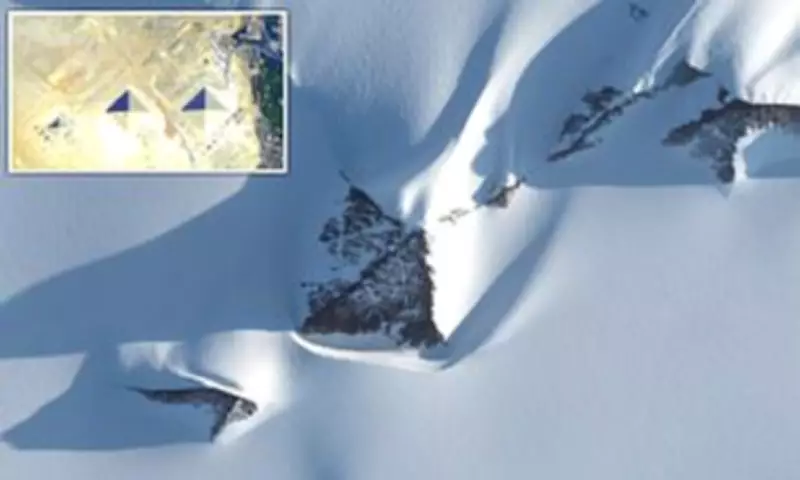
A series of mysterious formations in Antarctica, strikingly similar to Egypt's Giza pyramids, has sparked intense online debate and theories about a potential lost global civilization. Independent researcher Jay Anderson discovered these ice-covered structures using Google Earth, highlighting their apparent alignment by comparing satellite images of the Antarctic peaks with those of the iconic Egyptian pyramids.
Location and Discovery Details
The formations are precisely located at coordinates 79°58'39.0"S 81°57'34.0"W on Google Earth, situated in the southern region of the Ellsworth Mountains, one of Antarctica's most rugged and mountainous areas. Anderson's analysis revealed three sharply angled peaks, with the central formation rising approximately 4,500 feet tall and featuring four steep sides. This central peak appears flanked by two smaller pyramid-like structures protruding from the surrounding snow, mirroring the diagonal arrangement of the Giza plateau's three main pyramids: Khufu, Khafre, and Menkaure.
Online Speculation and Conspiracy Theories
The striking visual similarities have ignited a firestorm of speculation across social media and online forums. Enthusiasts and conspiracy theorists have proposed that these formations could be man-made, suggesting they might serve as evidence for theories like crust displacement, where Earth's surface was once in different positions. One user passionately argued, "If true, this would be absolute proof of crust displacement and demonstrate the existence of a highly advanced civilization predating our oldest historical records."

This is not the first time these Antarctic structures have captured public imagination. In 2016, a video posted by the YouTube channel Third Phase of the Moon, known for promoting alien conspiracy theories, showcased a pyramid-like formation labeled "Antartica Pyramid"—a misspelling that raised suspicions about image manipulation. Responses ranged from supportive comments, such as James Jason's remark about "things about to get very dramatic," to skeptical dismissals, like Gordon Anderson's observation based on his experience with snow-covered mountains.
Geological Explanations and Expert Insights
Despite the sensational claims, geologists and scientists offer a more grounded explanation. They assert that the pyramid-like shapes are likely natural formations resulting from freeze-thaw erosion over hundreds of millions of years. This process involves water seeping into rock cracks during warmer periods, freezing as temperatures drop, expanding, and eventually breaking off large chunks of rock, gradually sculpting the mountains into steep, angular forms.
Eric Rignot, a professor of Earth system science at the University of California, Irvine and a senior research scientist at NASA, previously told Live Science that the formations are "just a mountain that looks like a pyramid." Similarly, Mauri Pelto, a professor of environmental science at Nichols College, noted that freeze-thaw weathering has created other pyramidal mountains, such as the Matterhorn in the Swiss Alps.
Nigel Watson, author of the UFO Investigations Manual, explained to the Daily Mail in 2016 that these structures are likely nunataks—natural mountain peaks that jut above glaciers, formed by shifting glaciers and erosion rather than extraterrestrial activity. He cautioned that images of the "pyramids" might be photoshopped or cropped to enhance their resemblance to man-made structures.
Broader Implications and Cultural Context
The debate over these Antarctic formations taps into broader themes of human curiosity and the allure of ancient mysteries. The alignment of the three peaks has drawn comparisons to the Giza pyramids' purported connection to Orion's Belt, though this idea remains widely debated among archaeologists. Observers have noted that the pattern of the Antarctic peaks mirrors this celestial alignment, further fueling speculative theories.

However, the consensus among experts leans heavily toward natural origins. The rugged terrain of the Ellsworth Mountains, shaped by millennia of geological processes, provides a plausible context for these formations. While the online discourse continues to swirl with ideas of lost civilizations and alien bases, scientific evidence points to the enduring power of natural erosion in crafting Earth's most intriguing landscapes.