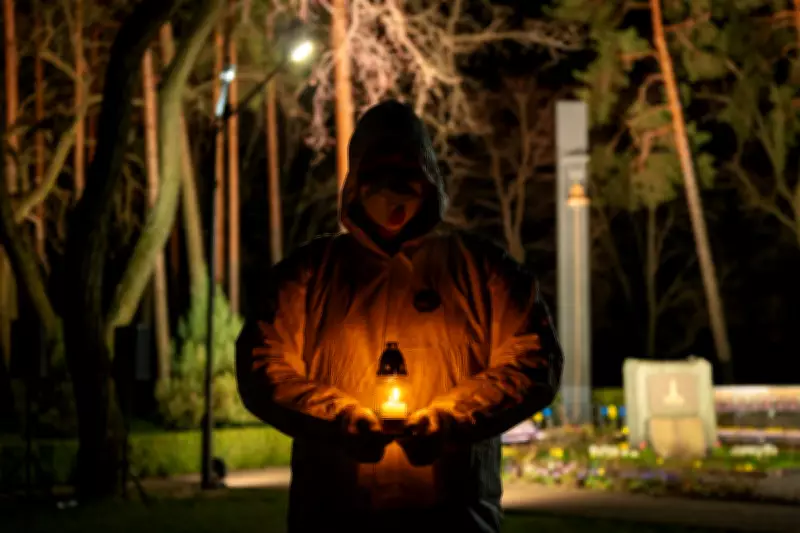
Despite Russia’s ongoing war, the Ukrainian city of Slavutych held its annual midnight vigil on Sunday to commemorate the 40th anniversary of the Chernobyl nuclear disaster. Residents streamed into the central square, placing candles on a large radiation hazard symbol laid out on the ground, remembering the thousands who died or risked deadly radiation exposure to contain the catastrophe.
A Tradition Despite Danger
Residents gather each year for the vigil, even with wartime curfews and official warnings against large gatherings during Russia’s invasion. The April 26, 1986 disaster highlighted lax safety standards and government secrecy in the Soviet Union. The explosion was not reported for two days, after winds carried fallout across Europe and Swedish experts raised alarms.
The Liquidators and Aftermath
About 600,000 people, known as Chernobyl’s “liquidators,” were deployed to fight the fire and clean up contamination. Thirty workers died within months from the explosion or acute radiation sickness. The accident exposed millions to dangerous radiation levels and forced permanent evacuation of hundreds of towns in Ukraine and Belarus.

Slavutych, located about 50 kilometers from the former plant, was built in late 1986 to house plant workers and their families. The first residents moved in around 1988. Since then, the city has endured a brief Russian occupation during Moscow’s failed push to seize Kyiv, as well as harsh winters, including the last one when blackouts forced residents to cook over open fires.
Commemoration and Resilience
People of all ages gathered in the square, some carrying spring tulips and daffodils. They lined up in a plaza framed by Soviet-era apartment blocks, near a memorial and posters honoring local residents killed in the war. Liudmyla Liubyva, 71, attended with a friend. Her husband, a former Chernobyl worker, developed a radiation-related disability and lost the ability to walk. She stressed the importance of honoring those who sacrificed their health, noting that Russia’s war has revived fears of lingering danger.
“When the drone struck the arch, it felt like the world could return to 1986,” she said, referring to a 2025 Russian drone strike that damaged the New Safe Confinement structure, the dome built to contain radiation. “We all — young and old alike — must protect our land, because it is so vulnerable.”
Soft music played as poetry about the disaster echoed over loudspeakers. “Years pass, generations change, but the pain of Chernobyl does not fade,” a woman’s voice recited. People in white protective suits and face masks, symbolizing the liquidators, stood in silence holding candles.
Personal Memories
Larysa Panova, 67, often recalls the day of the accident that forced her to leave her native Chernobyl and start anew in Slavutych. Though the city has become home, she still thinks of the forests and nature she left behind. Before the full-scale invasion, she regularly visited relatives in the exclusion zone, but now access is restricted. “I never stop thinking of Chernobyl as my homeland,” she said. “You remember your school, your childhood, your youth — everything happened there, in Chernobyl.”