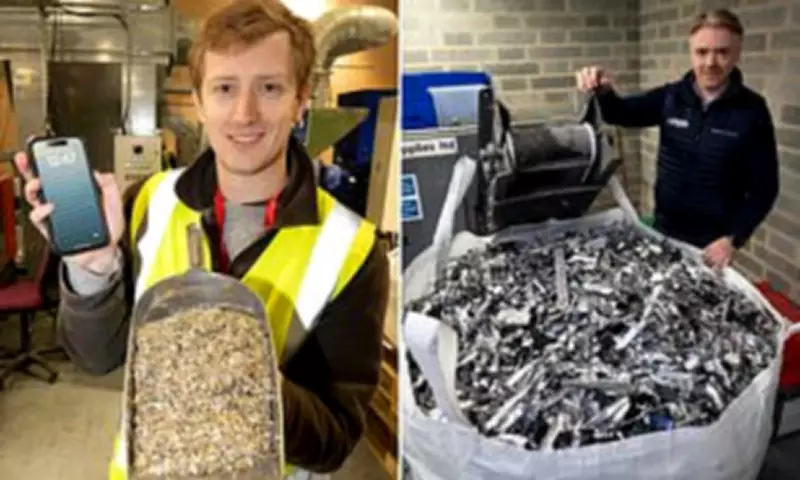
On an industrial estate near the A14 in Bury St Edmunds, a team of scientists is engaged in an unconventional form of gold mining. Dr Andrew Carrick, holding a test tube, presents a small plastic Ziplock bag with a grin. "That's £12,000 worth of gold in there," he reveals. Far from gleaming bullion, the bag contains a few spoonfuls of a dull, brown powder resembling ground coffee in colour and consistency.
From Brown Powder to Precious Metal
Dr Carrick, wearing oversized safety goggles, jokes about the appearance: "There's no eating or drinking in here, in case someone mistakes the gold for Nescafe." It would indeed be an expensive beverage. This unassuming yet weighty powder is 99 percent pure gold, destined for sale to jewellers in London's Hatton Garden. There, it will be melted at 1,064 degrees Celsius to achieve its iconic yellow hue and moulded into 24-carat rings, charms, and bracelets.
How a Suffolk Warehouse Became a Gold Mine
How did a 32,000 sq ft warehouse in suburban Suffolk become one of Britain's most lucrative gold mines, producing 7kg of gold monthly with a market value of £350,000? This is the story of Bioscope, a small British business backed by two former rugby stars that uses bacteria to extract precious metals from discarded phones, laptops, and circuit boards.

The process is relatively straightforward. Products are stripped of electrical components, ground into millions of tiny pieces, and soaked in a bacterial solution that isolates valuable elements. "It's like baking sourdough," smiles Bioscope CEO Rob Bolton, gesturing at large vats of living bacteria. "But rather than bread, we get gold."
The Growing E-Waste Crisis
More than 60 million tonnes of electronic waste are produced annually, up from 34 million tonnes in 2010. That's roughly one and a half times the weight of London Bridge discarded daily. According to the UN's 2024 Global E-waste Monitor, this figure is expected to exceed 80 million tonnes per year by 2030.
Shockingly, only 22 percent of e-waste is currently recycled. The remaining 78 percent, worth an estimated £46 billion in raw materials like gold and silver, is often shipped illegally to the subcontinent for incineration or landfill. Seven percent of the world's gold reserves are locked in disused electronics, with 100 times more gold in a tonne of smartphones than in a tonne of gold ore.
The Rugby Connection and Business Vision
When former London Wasps hooker Simon Taylor, 59, met ex-England scrum-half Andrew Gomarsall, 51, in 2019, he bought a 75 percent stake in the Gomarsall family recycling business, N2S. The plan was to expand from scrap metal recycling into advanced bioleaching of gold from old electronics. Bioscope was launched as a sister company in January 2022.
"I'm massively patriotic," Taylor told the Daily Mail. "At the moment, all our precious resources in old technology are shipped to Japan, China, and India, who use it to build their own stuff. That's a tragedy." Their vision: search for gold in British rubbish tips rather than West African mines.
Inside the High-Security Facility
The tour of Bioscope's facility begins deep underground in "The Bunker," with concrete walls 18 inches thick. "It would take two people with sledgehammers an hour to break in," explains head of security Stefan. This security is essential, as the Bunker wipes sensitive data from old computers and hard drives from clients including the NHS, Ministry of Justice, and private banks.
"We've had countless attempts to hack our IT system, mainly from China and Russia, but none have been successful," reveals CEO Rob Bolton, examining bins of hard drives. With millions of credit card, health, and personal details stored here, a breach would be catastrophic.
The Bioleaching Process
After data wiping, hardware is shredded, mostly at a facility in Mansfield. "It's basically an enormous paper shredder," says Bolton, handling metal cuttings carefully. The byproduct is poured into eight 900-litre vats mixed with organic bacteria that separate precious metals from base metals through bioleaching.

Discovered decades ago in Chilean copper mines, the bacteria absorbs cheaper metals like copper and tin, leaving expensive metals to sink as sludge. The exact ratios are a closely guarded secret. This method uses less water and electricity and emits negligible CO2 compared to furnace heating or corrosive acids.
The bioleaching vats are warm due to chemical reactions, taking about 24 hours. The bacteria is renewable and reusable. The resulting sludge is purified in a lab, dried in a low-powered microwave, and becomes brown powdered gold ready for jewellery.
"It never gets boring, holding pure gold in the palm of your hand," Bolton assures.
Financial Success and Future Prospects
In 2025, Bioscope turned over £2.3 million by processing 1,250 tonnes of e-waste, producing over 11kg of gold worth over £500,000, plus 10kg of palladium and over 100kg of silver. This year, figures are set to rise tenfold with expanded operations.
Profits are bolstered by demand for ethically responsible jewellery. Luxury watch brands Omega and Rolex recently announced plans to use exclusively recycled metals, allowing Bioscope to charge premium fees. Another opportunity lies in data centres for AI, with £2.2 trillion to be spent by 2029. These centres house millions of computers with circuit boards replaced every three years.
Bolton is already talking to US data centre stakeholders about similar recycling plants. Scott Butler, executive director of non-profit Material Focus, says bioleaching offers hope: "It's less energy intensive and can target materials not reached by traditional methods." While focused on gold and silver, up to 50 elements on circuit boards remain to be harvested. "Recycling these metals is better than mining for new ones," Butler concludes.
The Value in Everyday Electronics
Before leaving, Dr Carrick examines a phone: "Older models contain more gold due to less sophisticated technology needing more conducting material. We're more excited by a 1960s circuit board than today's. In this phone, about 0.03 grams, worth £4." An average laptop contains about 3 grams of gold, worth £40.
Consider old laptops, phones, chargers, adapters, MP3 players, iPods, and DVD players sitting unused. It might be rubbish to some, but Bioscope proves one man's trash is another's treasure, turning e-waste into gold through innovative bacterial recycling.