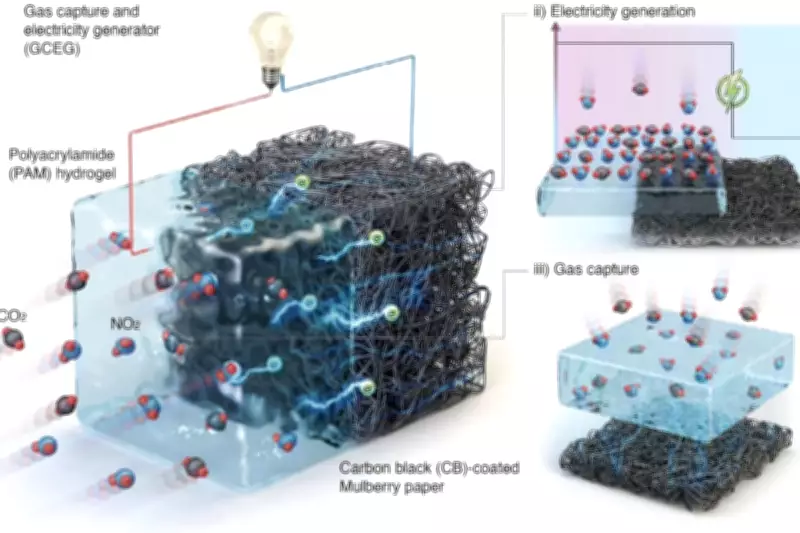
In a significant scientific advancement with potential implications for climate change mitigation, researchers from South Korea have engineered a novel device capable of absorbing harmful atmospheric pollutants and transforming them directly into electrical power. This breakthrough system, which effectively functions as a "gas battery," represents a paradigm shift in carbon capture technology by generating energy rather than consuming it.
Overcoming Energy Hurdles in Carbon Capture
Traditional carbon capture systems, which focus on sequestering greenhouse gases like carbon dioxide, typically demand substantial external energy for gas collection and processing operations. This energy requirement has long been a critical limitation for widespread adoption. The new mechanism developed by a team in Seoul elegantly circumvents this challenge by directly converting the chemical energy released during the gas adsorption process into a continuous electrical current.
How the Gas Capture and Electricity Generator Works
The prototype device, formally named the Gas Capture and Electricity Generator, employs a sophisticated structure that merges carbon-based electrodes with specialised hydrogel materials. Specifically, it utilises a carbon black-coated mulberry paper electrode integrated with a dip-coated polyacrylamide hydrogel. This unique architecture allows for the selective adsorption of target greenhouse gases, such as nitrogen oxides and carbon dioxide.

Upon adsorption, a migration and redistribution of charged particles occurs within the device's internal matrix. This electrochemical reaction spontaneously generates a direct current voltage without any need for an external power source, as detailed in the study published in the journal Energy & Environmental Science.
Performance Metrics and Scalability
In laboratory tests, exposure to a concentration of 50 parts per million of nitrous oxide resulted in the generator producing 0.8 volts and 55 microamperes of electrical power. While this output is modest, the researchers demonstrated that through series and parallel integration of multiple units, the system can be scaled to deliver up to 3.8 volts and 140 microamperes.
This scaled energy output is sufficient to power small electronic devices, including various wearable technologies and autonomous environmental monitoring sensors. The device essentially uses atmospheric pollutants as its fuel source, thereby purifying the air while simultaneously supplying clean energy.
Future Applications and Environmental Impact
The research team envisions multiple practical applications for this technology. It could be deployed in smart environmental sensor networks, battery-free Internet of Things (IoT) devices, and industrial facilities with significant emission outputs. In such settings, the system would enable concurrent energy harvesting and substantial carbon footprint reduction.
Professor Ji Soo Jang from the Department of Nanoengineering at Sungkyunkwan University, a lead scientist on the project, emphasised the transformative potential. "This research demonstrates that greenhouse gases are not merely pollutants to be managed, but can serve as a new energy resource," stated Professor Jang. "We aim to further develop this technology into an environmental platform that not only achieves carbon neutrality but also generates energy."
The study concludes that by integrating gas capture and electricity generation into a single, self-powered platform, this approach provides a scalable, low-energy pathway for mitigating multiple greenhouse gases. If successfully integrated into broader energy systems, it could accelerate progress toward global carbon neutrality goals, turning a major environmental problem into a valuable energy solution.