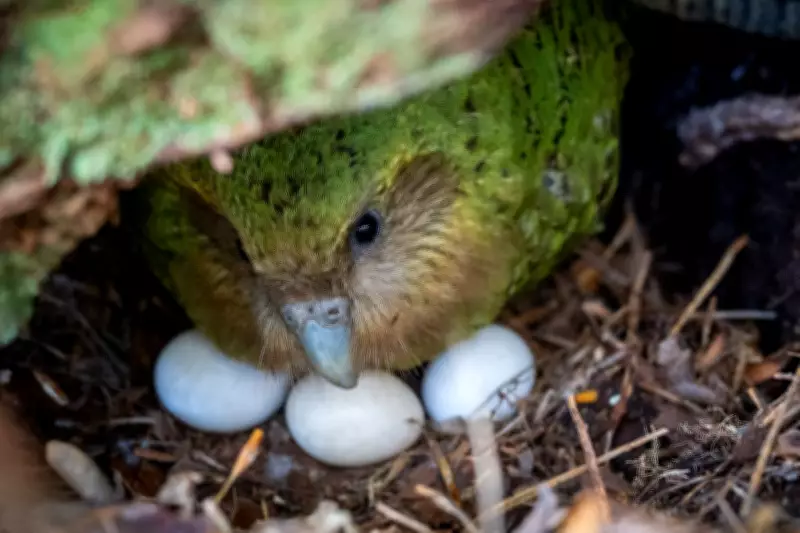
Bumper Berry Harvest Sparks Rare Romance for New Zealand's Flightless Kakapo Parrot
New Zealand conservationists have been engaged in a decades-long battle to prevent the extinction of the kakapo, the world's only flightless parrot species. Intensive conservation efforts have been crucial in this fight, with the population gradually increasing from a mere 50 individuals to over 200 over the past thirty years. This year, a significant development offers renewed hope: a bumper crop of the parrot's favourite berries has triggered a rare enthusiasm for mating among the birds.
From Near Extinction to Cautious Optimism
The nocturnal and reclusive kakapo was once considered doomed by its own design. Too heavy, too slow, and unfortunately too delicious to predators, this unique bird also exhibited a notoriously relaxed approach to reproduction. Its fate, however, is now teetering toward survival thanks to an unlikely and dedicated conservation programme. With the current bumper berry harvest prompting increased mating activity, those working to save the species are hopeful for a record number of chicks in February. Such an outcome would move the kakapo closer to defying what was, not long ago, believed to be certain extinction.
Kakapo currently reside on three tiny, remote islands off New Zealand's southern coast, making wild sightings exceptionally scarce. This breeding season has even propelled one individual bird to internet fame through a livestreamed video of her underground nest, where a chick was anticipated to hatch.

The Peculiar and Majestic Kakapo
The kakapo is a majestic creature with a potential lifespan of 60 to 80 years, but its appearance is undoubtedly peculiar. These birds can weigh over 3 kilograms (6.6 pounds), featuring owllike faces, distinctive whiskers, and mottled green, yellow, and black plumage that mimics dappled light on the forest floor—their primary habitat. This ground-dwelling nature has historically complicated their survival.
"Kakapo also have a really strong scent," explained Deidre Vercoe, operations manager for the Department of Conservation's kakapo programme. "They smell really musky and fruity—a gorgeous smell." This pungent aroma proved disastrous when humans arrived in New Zealand centuries ago. The introduction of rats, dogs, cats, and stoats, combined with hunting and habitat destruction, drove many of the country's flightless birds, including the kakapo, to the brink of extinction.
By 1974, no kakapo were known to exist. Conservationists persisted, however, and a new population was discovered in the late 1970s, sparking the ongoing recovery effort.
Slow and Strange Breeding Cycles
Reversing the kakapo's fortunes has been far from simple. One major reason for the slow population growth is the species' peculiar breeding behaviour. Years or even decades can pass between successful clutches of eggs. A breeding season only occurs every two to four years, triggered by bumper crops of fruit from the native rimu trees the parrots favour, which last happened in 2022. A substantial food source is essential for chick survival, though it remains unclear exactly how adult birds detect an abundant harvest.
"They're probably up there in the canopy assessing the fruiting," speculated Vercoe. "When there's a large crop developing, they somehow tune into that."
Once triggered, the mating ritual becomes truly bizarre. Male kakapo position themselves in dug-out bowls in the ground and emit deep, sonorous booming sounds followed by metallic noises known as "chings," reminiscent of rusty bedsprings. These booms, audible across the forest on clear nights, attract female kakapo to the bowls. Females may lay up to four eggs before raising their chicks alone.
Since January, admirers have gained a rare glimpse into this process via a livestream showing the underground nest of 23-year-old kakapo Rakiura on Whenua Hou island. She has laid three eggs, two of them fertile. Given the species' precarious status, the eggs have been exchanged for fakes while the real ones are incubated indoors, to be returned just before hatching.

A National Duty to Protect
Perhaps the only thing stranger than the kakapo itself is the extraordinary lengths to which New Zealanders have gone to save it. Quadrupling the population over three decades has required relocating the birds to remote, predator-free offshore islands and meticulously managing their romantic pairings.
"We do what we can to make sure we don't lose any further genetic diversity," Vercoe stated. "We manage that carefully through having the best matches possible on each island."
Each bird is individually named and monitored via a small backpack tracker; if one vanishes, it becomes nearly impossible to locate. With the kakapo still critically endangered, conservation efforts are unlikely to cease soon, though handlers are gradually easing their hands-on management each breeding season.
This painstaking preservation work might seem unusual to outsiders, but the parrot is just one of many spirited and eccentric avian species in a nation where birds reign supreme. New Zealand's only native land mammals are two bat species, meaning its birds, which evolved uniquely before human and predator arrival, have become cherished national symbols.
"We don't have the Eiffel Tower or the pyramids, but we do have kakapo and kiwi," Vercoe remarked. "It's a real New Zealand duty to save these birds."