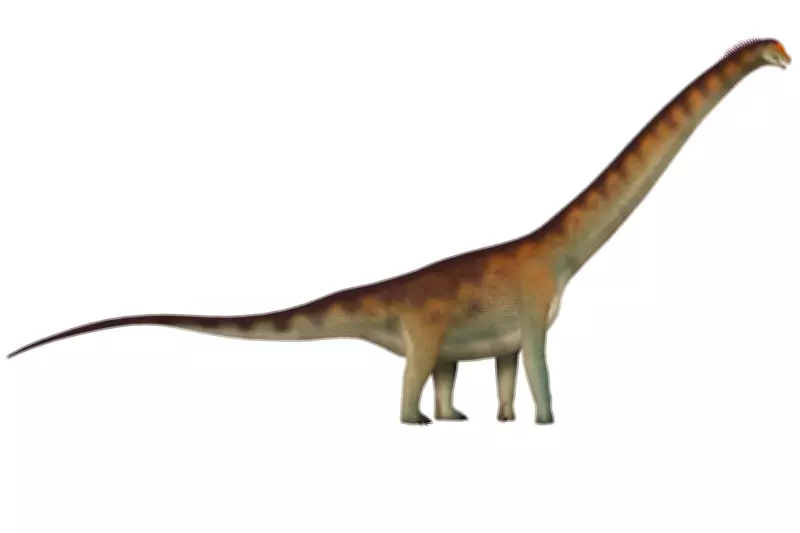
Brazilian palaeontologists have made a monumental discovery, identifying a new species of giant dinosaur that roamed the Earth approximately 120 million years ago. The species, named Dasosaurus tocantinensis, measured roughly 20 metres in length, equivalent to the size of two standard buses, making it one of the largest dinosaurs ever found in Brazil.
A Colossal Find in Maranhao
The fossils were unearthed in 2021 during infrastructure works near Davinopolis, in the state of Maranhao, Brazil. The excavation revealed a femur bone measuring about 1.5 metres, which researchers used to estimate the dinosaur's immense size. Elver Mayer from the Federal University of the Sao Francisco Valley led the research, with significant contributions from palaeontologist Leonardo Kerber of the Federal University of Santa Maria.
Leonardo Kerber described the moment of discovery: "As the excavation progressed over the days, we began to see the evidence of that huge bone, which is the femur. This indicates it was a very large dinosaur. Today we know Dasosaurus is among the biggest dinosaurs ever found in Brazil."

Unique Anatomical Features
Dasosaurus tocantinensis possesses distinctive ridges and grooves on its tail vertebrae, along with a pronounced bulge on the thigh bone. These anatomical characteristics have not been observed together in any other known dinosaur species, confirming its status as a unique find. The analysis, detailed this month in the Journal of Systematic Palaeontology, highlights the species' significance in expanding the diversity of Early Cretaceous sauropods in South America.
Biogeographical Connections Across Gondwana
The discovery reinforces scientific understanding of ancient land routes that once connected South America, Africa, and Europe. Dasosaurus lived during the Early Cretaceous period, when much of the world's landmass was fused together in the supercontinent Gondwana. Research indicates that this species is the closest known relative of Garumbatitan morellensis, a dinosaur previously described in Spain.
Dr Max Langer from the Universidade de São Paulo explained: "Apart from expanding the known diversity of Early Cretaceous sauropods in the northern part of South America, this discovery highlights biogeographical connections with more northern Gondwanan areas, as well as Europe."
Evolutionary Journey from Europe
Analysis suggests that the lineage of Dasosaurus was European, with its ancestors likely dispersing into what is now South America around 130 million years ago. This migration probably occurred via northern Africa, before the Atlantic Ocean fully opened, illustrating the dynamic movements of species across ancient continents. The name Dasosaurus tocantinensis pays homage to the region of discovery, referencing the Tocantins River, a major waterway whose eastern margins lie near the fossil site.
This find not only adds a giant new member to the dinosaur family tree but also provides crucial insights into the prehistoric connections that shaped life on Earth millions of years ago.