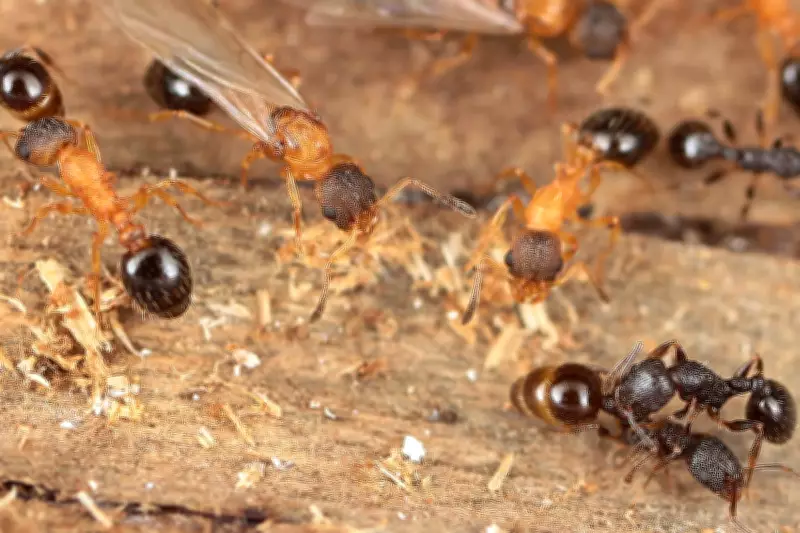
Japanese Parasitic Ant Species Found to Consist Exclusively of Queen Clones
A groundbreaking study has confirmed a long-standing scientific assumption about a rare parasitic ant species endemic to Japan. The research reveals that Temnothorax kinomurai is the only known ant species that lacks both workers and males, consisting exclusively of queens that reproduce asexually by producing clones of themselves.
Decades-Long Suspicion Finally Confirmed
For nearly forty years, researchers had suspected that the rare parasitic ant Temnothorax kinomurai might only produce queens, but until now, there had been no concrete evidence to support this hypothesis. The new study, published in the journal Current Biology, provides the first definitive proof of an ant species that completely lacks both workers and males.
In typical ant colonies, the social structure includes reproductive females known as queens, non-reproductive female workers, and males that die shortly after mating. While deviations from this pattern exist—including colonies with parasitic ants without workers and some without males—the complete absence of both workers and males represents an unprecedented discovery in myrmecology.

Deceptive Parasitic Behavior
The parasitic ant Temnothorax kinomurai was previously documented engaging in remarkably deceptive behavior. Researchers observed these ants tricking the workers of a closely related species, Temnothorax makora, into killing their own queen mother. This behavior is exceptionally rare in nature, as ant workers typically spend their entire lives caring for their queen, who is central to the colony's survival through foraging, defense, and nurturing young ants.
The latest research shows that T. kinomurai takes this parasitic strategy even further. After eliminating the host queen, these ants reproduce asexually by producing clones of themselves. They then manipulate the surviving host workers into rearing their offspring, essentially hijacking the labor force of another species for their own reproductive success.
Laboratory Confirmation of Asexual Reproduction
In the study, scientists collected six colonies containing T. kinomurai queens and reared them in laboratory conditions. Researchers successfully bred and raised forty-three T. kinomurai queen offspring in controlled settings. Careful inspection of these ants revealed a complete absence of males within the species.
Through regular monitoring of egg-laying patterns under laboratory conditions, scientists made a crucial discovery. The eggs developed into new queens without ever being fertilized by male ants. Microscopic analysis of the queen ants' mating structures showed these organs remained unused, providing clear evidence that all offspring were genetic clones of their mothers.
Unique Biological Combination
After observing multiple colonies and populations of the species, researchers confirmed that T. kinomurai completely lacks both workers and males. As stated in the study, "Our data therefore suggest that the life history of T. kinomurai is characterised by the unique combination of workerless parasitism and parthenogenesis, i.e., the ability to produce female offspring from unfertilised eggs."
This represents a remarkable evolutionary adaptation where the species has eliminated two fundamental components of typical ant social structure while maintaining reproductive success through cloning and parasitic exploitation of other ant colonies.
Future Research Directions
In further studies, researchers hope to understand what specific environmental or evolutionary conditions favor the loss of workers and males in this ant species. The discovery opens new avenues for understanding extreme adaptations in social insect evolution and the mechanisms behind asexual reproduction in typically sexual species.
The confirmation of this decades-long assumption about Temnothorax kinomurai not only expands our understanding of ant biology but also demonstrates how parasitic species can evolve highly specialized reproductive strategies that challenge conventional biological paradigms.