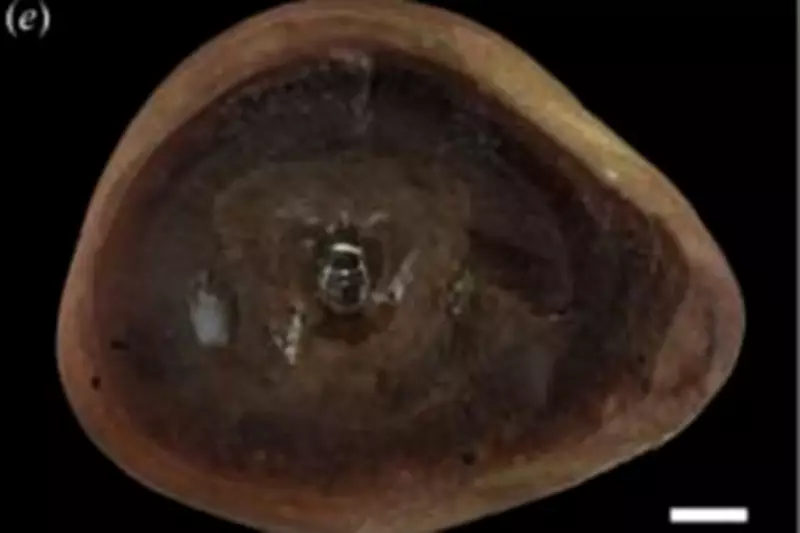
Groundbreaking scientific analysis has overturned a decades-long paleontological assumption, revealing that a celebrated 300-million-year-old fossil, previously hailed as the world's oldest octopus, actually belongs to an entirely different marine creature. The Pohlsepia mazonensis specimen, discovered in Illinois, USA, in 2000 and formally identified as an octopus twenty-five years ago, has now been conclusively reclassified as a relative of the modern nautilus through advanced imaging technology.
Decades of Misidentification Corrected by Modern Science
For over a quarter of a century, the Pohlsepia mazonensis fossil has been a cornerstone in studies of cephalopod evolution, even earning a place in the Guinness Book of Records as the oldest known octopus. Scientists originally believed the fossil displayed eight arms, fins, and other characteristic octopus features, which would have pushed back the evolutionary history of octopuses by approximately 150 million years. However, persistent doubts about its true classification lingered within the academic community, unresolved due to technological limitations.
Revolutionary Imaging Uncovers Hidden Truth
A research team from the University of Reading employed state-of-the-art synchrotron imaging, a technique utilizing light beams brighter than the sun, to penetrate the fossil's surface and reveal microscopic structures invisible to the naked eye. These scans uncovered a critical feature: a radula, a ribbon-like feeding organ with rows of tiny teeth found only in molluscs. The imaging showed at least eleven tooth-like elements per row, a count that definitively rules out an octopus, which possesses only seven or nine teeth per row.

Dr. Thomas Clements, lead author and Lecturer in Invertebrate Zoology at the University of Reading, explained the significance: "It turns out the world's most famous octopus fossil was never an octopus at all. It was a nautilus relative that had been decomposing for weeks before it became buried and later preserved in rock. That decomposition process is what made it appear so convincingly octopus-like to earlier researchers."
Implications for Evolutionary History
The research, published in the prestigious journal Proceedings of the Royal Society B, matches the fossil to a known nautiloid species called Paleocadmus pohli. The team concluded that partial decomposition prior to fossilisation distorted the creature's appearance, leading to the long-standing misidentification. This revelation provides the oldest soft tissue evidence of a nautiloid ever discovered and fundamentally alters the timeline for octopus evolution.
Dr. Clements elaborated on the broader impact: "We now have a much clearer picture of when octopuses actually first appeared on Earth. The new findings suggest octopuses did not emerge until the Jurassic period, which is significantly later than previously theorised based on this fossil. It's astonishing to consider that a single row of minuscule teeth, concealed within rock for 300 million years, has fundamentally reshaped our understanding of cephalopod evolution."
A Testament to Scientific Progress
This case underscores the importance of re-examining historical specimens with contemporary technology. Dr. Clements noted, "Sometimes, re-evaluating controversial fossils with new techniques reveals tiny clues that lead to truly exciting discoveries." The study not only corrects a specific misclassification but also highlights how modern analytical methods can resolve long-standing scientific puzzles, offering more accurate narratives of prehistoric life.