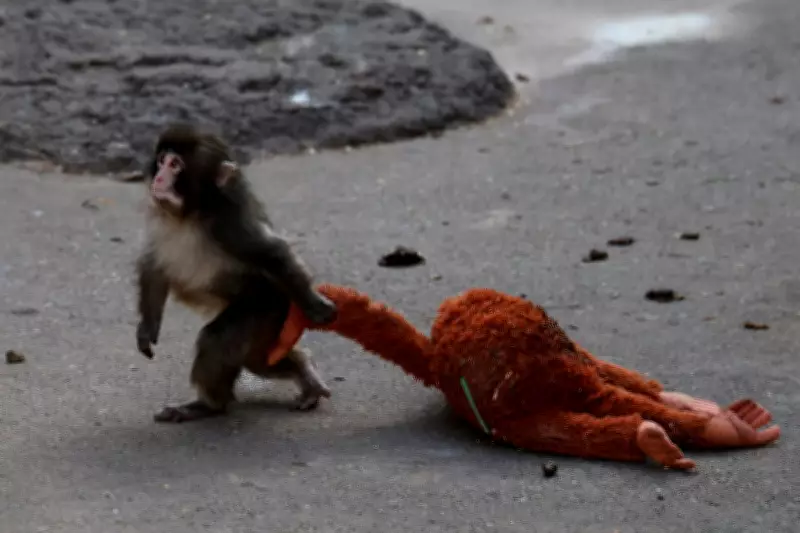
Animal rights organisation PETA has issued a strong condemnation of the treatment of a young Japanese macaque named Punch, whose viral videos of clinging to a stuffed orangutan toy have captivated global audiences. The group argues that this seemingly heart-warming story actually exposes the underlying cruelty inherent in zoo systems.
The Viral Phenomenon of Punch the Macaque
Punch, a Japanese macaque, achieved international fame earlier this month after footage emerged showing him dragging around and playing with a plush toy provided by keepers at the Ichikawa City Zoo. Born in July last year and rejected by his mother soon after, Punch was hand-reared by zoo staff who gave him the toy for comfort. Online followers affectionately dubbed the toy "Ora-mama," and it became a near-constant companion for the infant monkey.
The videos prompted an enormous outpouring of sympathy worldwide, with the hashtag "keep going, Punch" trending as viewers followed his progress. During a recent long holiday weekend, over 5,000 people visited the zoo, with many queuing for up to an hour specifically to see Punch. The phenomenon even extended to retail, with IKEA Japan reportedly donating several similar stuffed toys during a visit by its president Petra Fare, and the comparable IKEA toy becoming a bestseller that is now either sold out or low in stock globally.

PETA's Stark Criticism of Zoo Practices
In a detailed statement, PETA strongly criticised what many have described as "cute" and "heart-warming" footage, asserting instead that it reveals an animal struggling with profound "isolation and loss." Jason Baker, PETA's Asia president, emphasised that "zoos are not sanctuaries" but rather "places where animals are confined, deprived of autonomy, and denied the complex environments and social lives they would have in the wild."
Baker elaborated further, stating: "Like all macaques, Punch should be growing up in a tight-knit family group, learning vital social skills and exploring a rich, natural habitat – not seeking solace from a toy in a concrete pit." This perspective challenges the narrative that zoos provide adequate care or environments for wild animals.
The Reality Behind Viral Animal Fame
Baker noted that animals in zoos have gone viral previously, citing the example of Moo Deng the pygmy hippo. However, he cautioned that while "public fascination quickly fades," the animal remains confined in the zoo for its entire life. "Internet fame does not change the reality of captivity," Baker asserted. "It only fuels a cycle in which facilities breed and display babies to drive ticket sales, while the animals pay the lifelong price."
This criticism extends beyond Punch's individual case to address broader systemic issues within zoological institutions. PETA argues that the practice of breeding animals for display prioritises entertainment over welfare, creating a continuous cycle of exploitation.
Zoo's Perspective and PETA's Proposed Solution
Kosuke Shikano, one of Punch's keepers, offered insight into the bond between the monkey and his toy, explaining: "The stuffed animal's fur made it easy to grab, and its appearance is also similar to a monkey, which likely provided a sense of security. The stuffed animal was a surrogate mother." This statement highlights the zoo's attempt to provide comfort in an artificial environment.
Nevertheless, PETA has called on the Ichikawa City Zoo to take responsible action by sending Punch to a reputable sanctuary "where he could live in a more natural environment with space, privacy, and the chance to form appropriate social bonds." The organisation maintains that such facilities offer superior alternatives to traditional zoos by prioritising animal welfare over public display.
The debate surrounding Punch's situation underscores ongoing ethical questions about animal captivity, the role of zoos in conservation, and the impact of viral fame on public perception of animal welfare issues.