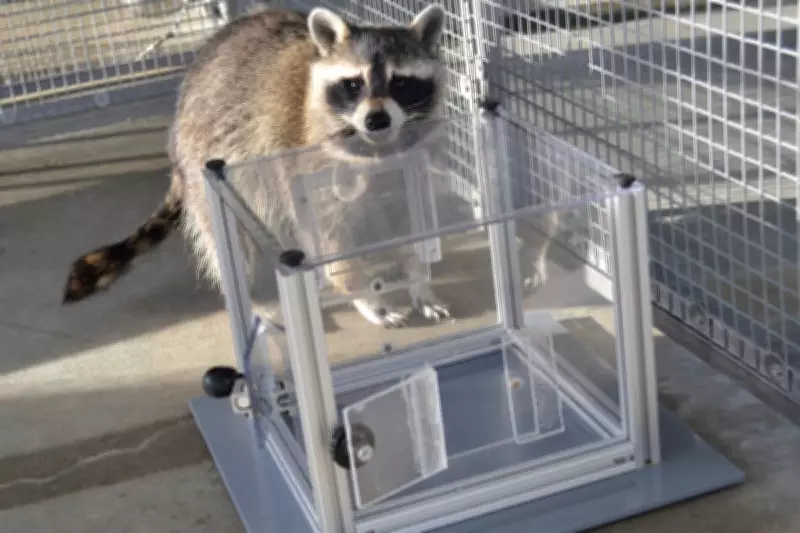
Raccoons Display Intrinsic Curiosity by Solving Puzzles Without Food Rewards
Raccoons are such inquisitive animals that they have been documented solving complex puzzles even when no treats are expected at the end, according to a groundbreaking new study. This research provides fresh insights into why these creatures are so remarkably well-equipped to flourish in city environments.
Beyond Opportunistic Scavenging: A Drive for Information
Commonly perceived as mere opportunistic scavengers, raccoons are notorious for raiding dumpsters and compost bins, even those fitted with relatively secure latches. However, the latest study indicates raccoons may be genuinely curious, not solely motivated by hunger, during their foraging activities.
Scientists from the University of British Columbia discovered that raccoons persistently solved puzzles long after obtaining the only available food reward. This finding strongly implies a more intrinsic motivation, beyond basic hunger, is propelling their behaviour.

Experimental Design and Surprising Results
In the study, researchers constructed a custom multi-access puzzle box featuring nine distinct entry points, categorised as easy, medium, and hard. The box contained a single marshmallow, accessible through various mechanisms like latches, sliding doors, or knobs.
During each twenty-minute trial, raccoons frequently continued opening new mechanisms after consuming the marshmallow, a clear indicator of information-seeking behaviour. "We weren't expecting them to open all three solutions in a single trial. They kept problem-solving even when there was no marshmallow at the end," explained Hannah Griebling, a lead author of the study published in the journal Animal Behaviour.
Strategic Exploration and Decision-Making
Even when they easily solved the puzzles, raccoons appeared to explore the box extensively, attempting multiple openings and varying their sequence. When task difficulty escalated, they tended to favour a reliable solution but still investigated multiple routes.
This suggests raccoons might adjust their exploration strategy based on perceived cost and risk, mirroring decision-making frameworks observed in other animals and humans. "It's a pattern familiar to anyone ordering at a restaurant... Do you order your favourite dish or try something new? If the risk is high – an expensive meal you might not like – you choose the safe option," Dr Griebling elaborated.
"Raccoons explore when the cost is low and quickly decide to play it safe when the stakes are higher," she added.
Implications for Urban Adaptation and Wildlife Management
By solving problems for information, not merely food, raccoons gain a significant advantage in complex environments, aiding their access to garbage bins or other urban food sources. This cognitive trait could be a key reason why raccoons thrive so successfully in cities.
Their forepaws, rich with sensory nerves, further assist in foraging by enabling precise manipulation of latches and handles. "Understanding the cognitive traits that help raccoons thrive can guide management of species that struggle, and inform strategies for other species, like bears, that use problem-solving to access human-made resources," noted Dr Griebling.
"Raccoon intelligence has long featured in folklore, yet scientific research on their cognition remains limited. Studies like this provide empirical evidence to support that reputation," concluded Sarah Benson-Amram, another co-author of the study.