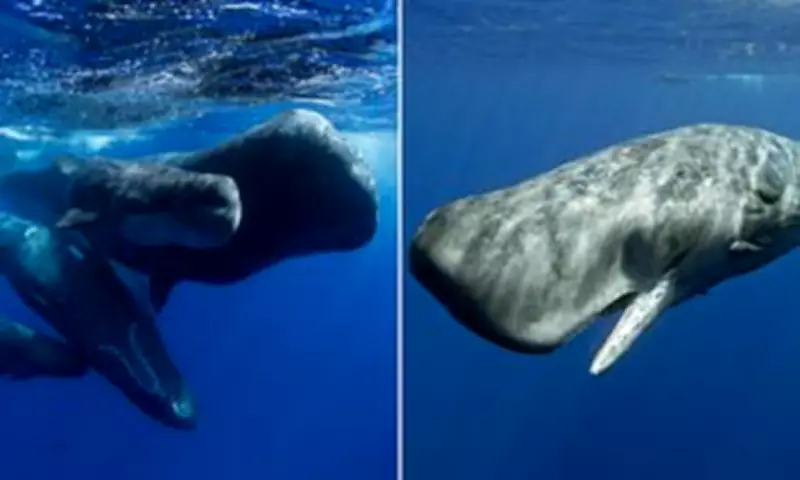
A groundbreaking study has revealed that sperm whale communication through rhythmic clicks, termed codas, represents one of the closest parallels to human language in the animal kingdom. While humpback whales are known for their melodic songs, sperm whales utilise these clicks, which scientists from Project Ceti have discovered vary in frequency, akin to human vowel sounds.
Decoding the Clicks: From Morse Code to Vowel Frequencies
Previous research focused on the timing of sperm whale clicks, attempting to decipher their language in a manner similar to Morse code. However, this new study shifts the paradigm by concentrating on the frequency of the clicks themselves. Researchers identified two primary click types, analogous to 'a' and 'i' vowels in human speech, which can be employed at different pitches and even combine to form diphthongs, where two adjacent vowels create a single syllable, reminiscent of languages such as Mandarin.
Regional Accents and Complex Linguistic Patterns
Intriguingly, different pods of sperm whales were found to use distinct types of clicks, hinting at the existence of regional accents within these marine communities. To gather data, University of California researchers attached small underwater microphones to 15 sperm whales over a four-year period. Computer analysis of the recordings unveiled a highly complex linguistic system with patterns strikingly similar to those in human speech.

Lead author Gašper Beguš, a linguist at the University of California, Berkeley, explained to Scientific American that while these vocalisations might initially sound alien, closer examination reveals profound similarities to human language. Analysis of sound waves showed that a-vowels exhibit a single distinct peak, whereas i-vowels feature two peaks, mirroring phonetic distinctions found in human languages like Arabic, where vowel length can alter word meaning.
Evolutionary Insights and Future Mysteries
The findings, published in Proceedings of the Royal Society B, suggest that sperm whales possess a sophisticated communication system that dictates the type of click used in interactions. Scientists speculate that these patterns are highly suggestive of language carrying meaning, though much remains shrouded in mystery. The study concludes that sperm whale codas not only acoustically resemble human vowels but also pattern like them, indicating independent evolution from a common ancestor shared with humans around 90 million years ago.
Sperm whales, which have the largest brains of any species on Earth, weighing up to 20 pounds, demonstrate that their vocalisations represent a highly complex system, offering one of the closest parallels to human phonology in animal communication. This research opens new avenues for understanding the evolution of language and intelligence in the animal world.