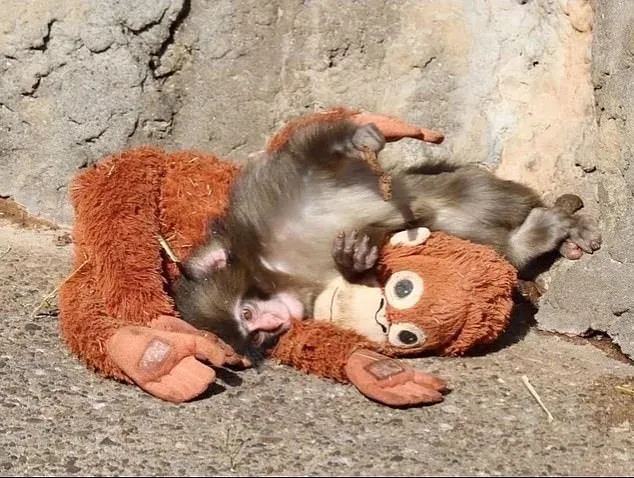
Little Punch, a seven-month-old Japanese macaque residing at the Ichikawa City Zoo in Japan, has become an internet sensation. Abandoned by his mother shortly after birth, he has been raised by zoo keepers, yet faces difficulties integrating into a group of approximately 60 monkeys. The keepers provided him with a stuffed orangutan, which he grooms meticulously, mimicking natural social behaviors. However, some group members have pushed him away, dragging him and reacting negatively, prompting widespread questions online about the reasons behind his mother's abandonment.
Wild Monkey Mothers: Dedicated Caregivers
Japanese macaques, scientifically known as Macaca fuscata, are highly social and intelligent primates. In their natural habitats, these monkeys almost never abandon their infants. Over more than 25 years of research at the Awajishima Monkey Center in Japan, where monkeys live in free-ranging groups, experts have not observed such behavior. Instead, they have documented mothers providing exceptional care, including supporting infants with physical disabilities or illnesses, sometimes carrying them for years beyond the typical period.
If an infant dies in the wild, a mother will often carry the body for days, demonstrating a profound attachment. From an evolutionary standpoint, this makes sense, as there is a slight chance an unresponsive infant might recover. Thus, being a Japanese macaque mother typically involves unwavering dedication.
Challenges in Captivity: Stress and Social Disruption
Punch's mother likely abandoned him due to a lack of maternal skills, stress from captivity, or a combination of both. Her background is unclear; she may have been human-raised or faced other hardships. In zoo settings, infant abandonment occurs in about 7.7% of cases, primarily among first-time or low-ranking mothers. Human caretakers strive to raise these infants, but this leads to social challenges, as the monkeys miss out on learning critical social cues from their own kind.
Adoption can happen in captivity, but zoo environments differ significantly from the wild. Groups are not always composed of female relatives, males cannot leave as they naturally would, and some monkeys come from human care or entertainment backgrounds, resulting in a different social language. Punch, for instance, has not learned how to communicate effectively with other macaques from his human caregivers.
Behavioral Flexibility and Hope for Integration
The positive aspect for Punch and his followers is that Japanese macaques are behaviorally flexible and can learn from their peers. He is already beginning to communicate with other monkeys and find his place in the group. In the wild, orphaned infants at Punch's age can survive, especially if adopted or befriended by others. As he spends more time with the group, he will learn appropriate social behaviors and interactions.
This story underscores the importance of research on wild and free-ranging Japanese macaques to understand cases like Punch's. It highlights the critical role of animal welfare studies in zoos, wildlife behavior, and conservation science, emphasizing that monkeys are wild animals best suited to social environments with their own species.