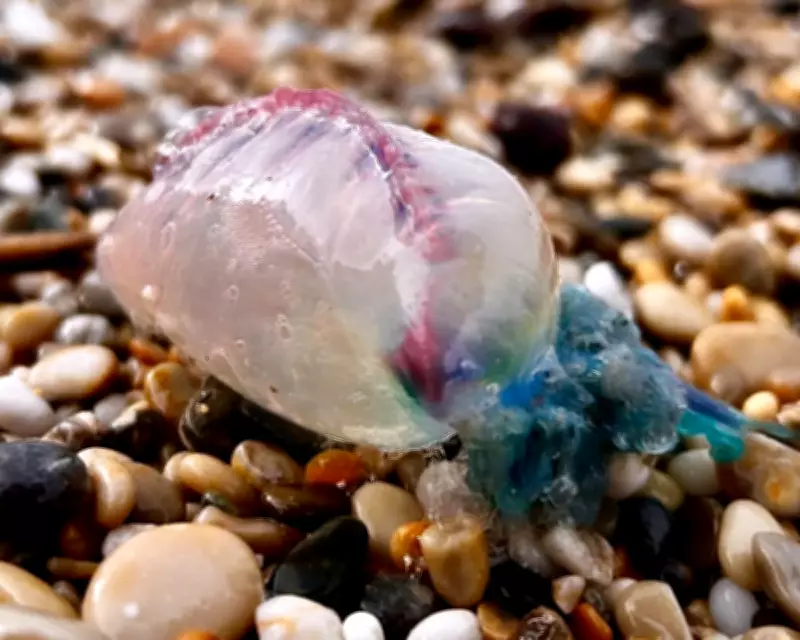
Dead Portuguese Man-of-War Poses Ongoing Threat on Cornish Shore
A Portuguese man-of-war, a perilous marine organism often mistaken for a jellyfish, has washed up on Loe Bar in Cornwall. This event underscores a growing trend of these creatures appearing on British beaches, with climate change likely playing a significant role.
From Childhood Fascination to Coastal Reality
As a youngster, I was captivated by the Portuguese man-of-war depicted in ocean books, imagining it as a distant, exotic beast with tentacles stretching 30 metres. However, since around 2010, sightings on Cornish shores have become more frequent, transforming fantasy into a tangible, albeit smaller and lifeless, reality. These organisms arrive via the Gulf Stream, discarded by waves like oceanic debris.
Strandings are now nearly annual occurrences, primarily in autumn and winter, driven by rising sea temperatures and altered ocean currents. I maintain a safe distance from this specimen, as its sting remains intensely painful even after death, though rarely fatal. Measuring about 15cm, it features an iridescent balloon-like float with a pink, crimped seam, and a bright blue underside where tentacles once trailed.

A Complex Colony of Organisms
The Portuguese man-of-war is not a single animal or a jellyfish but a colony of multicellular organisms called zooids. Each zooid has a specialized function: the pneumatophore bladder enables surface floating and movement, dactylozooids form the stinging tentacles that paralyse fish, and gastrozooids handle digestion. This symbiotic structure creates a remarkable biological system.
Accompanied by Violet Sea Snails
These creatures do not travel alone. Violet sea snails, small molluscs that feed on surface dwellers like the Portuguese man-of-war, are also arriving on the same currents. They float on self-spun bubble rafts, and I once found an empty shell here, a swirl of white and purple, symbolising how both predator and prey meet similar fates on the sand.
Climate Change and Coastal Impacts
The rising tide will soon return the Portuguese man-of-war to the sea to decompose. Its allure lies not in danger but in its alien beauty and intricate biology. However, these effortless ocean drifts come at a cost, as every stranding serves as a stark reminder of how climate change is reshaping our coastlines, affecting marine ecosystems and biodiversity.