In an extraordinary marine event described as a "one-in-a-billion chance," two American tourists encountered a pair of rare sea creatures on a Mexican beach, sparking fascination and unease due to ancient folklore linking such sightings to imminent disasters. Monica Pittenger and her sister, Katie, were relaxing at the popular vacation destination of Cabo San Lucas in late February 2026 when they spotted two massive oarfish washing ashore, stunning everyone present.
The Mysterious 'Doomsday Fish' Legend
Oarfish, often called sea serpents, hold a prominent place in Japanese folklore as "Doomsday fish." According to ancient beliefs dating back to at least the 17th century, these creatures are considered messengers from the sea god's palace. When they wash ashore, it is traditionally interpreted as a warning sign of impending cataclysms, such as deadly earthquakes or tsunamis. This legend has persisted into modern times, with notable instances including the appearance of nearly two dozen oarfish just months before the devastating magnitude 9.1 Tōhoku earthquake in Japan in 2011, which triggered a tsunami that killed nearly 20,000 people.
A Truly Rare Sighting
Seeing two oarfish simultaneously is considered almost unheard of because this species inhabits the deep ocean, typically residing at depths greater than 3,000 feet in the so-called "Twilight zone"—one of the least explored regions on Earth. A 2018 study published in the Bulletin of the Southern California Academy of Sciences found only 19 oarfish strandings or sightings along the California coast over the past century, highlighting the rarity of such events.

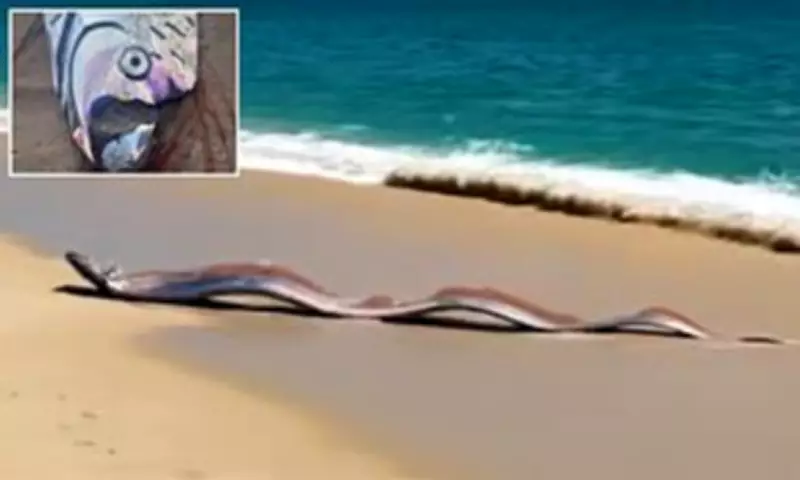
Both of the roughly 30-foot-long creatures witnessed by Pittenger and her sister were still alive, flapping like long, shimmering ribbons on the sandy shore as confused beachgoers looked on. Initially unaware of what the serpents were, Pittenger recorded the scene as her sister leaped into action to help the animals return to the water before they could perish on land.
The Rescue Effort and Aftermath
Pittenger described the encounter to the YouTube channel We Love Animals, saying, "It was something out of like a fiction movie. I had never seen anything like it before." The sisters were relaxing when they noticed something strange flashing brightly in the shallow waves from a distance. As they approached, they realized it was a massive, otherworldly creature, and then spotted a second one nearby, both struggling similarly.
The two huge oarfish had long, silvery, ribbon-like bodies with wavy red sails along their backs. Although neither appeared severely injured, they were clearly in distress, desperately trying to reach deeper water. Pittenger recounted, "My sister, she just cannot stand anything in pain. She throws me her phone, her drink and her bag. She's like, 'Hold this,' and she's just diving on in. I think a lot of people were very hesitant because nobody really knew what it was."
Beachgoers, including Katie and others, carefully pushed the first oarfish back into the ocean as it gasped for water, then assisted the second stranded creature. Both fish began swimming again and quickly disappeared into the depths. The giant creatures were longer than the five people seen on video standing shoulder to shoulder during the rescue, and nearly two feet in height—typical for an adult oarfish, which can grow up to 36 feet long and weigh close to 600 pounds.
Historical Context and Modern Interpretations
Beyond the 2011 Japan earthquake, other instances have linked oarfish sightings to seismic events, including a 2017 earthquake in the Philippines and smaller occurrences in Tasmania, India, and California in recent years. Normally, Doomsday fish only wash up on beaches when they are sick, injured, or dying, making the latest sightings in Mexico a true mystery.
Reflecting on the experience, Pittenger explained, "When we realized how rare it was, it was a pretty cool experience, but very surreal. From what we've researched, to see two was like one in a billion chance." This encounter not only captivated tourists but also reignited discussions about the intersection of folklore, marine biology, and natural disaster warnings, leaving many to ponder the significance of these deep-sea messengers in an era of scientific inquiry.