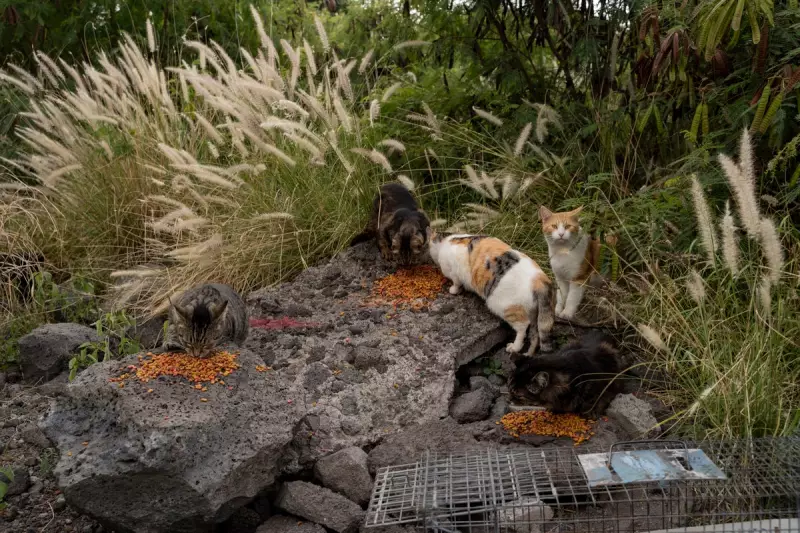
A new law on Hawaii's Big Island is set to take effect at the start of the new year, banning the feeding of feral animals on all county property. The controversial measure aims to protect vulnerable native species, most notably the endangered nene goose, from the threats posed by introduced predators.
Clash Over Conservation and Compassion
The ban, passed by the Hawaii County Council with a veto-proof 6-2 vote, has ignited a fierce debate between wildlife biologists and cat advocates. Mayor Kimo Alameda allowed the law to take effect without his signature, acknowledging he was swayed by opponents' concerns for the cats' welfare. Violations carry fines of up to $50 for a first offence and up to $500 for subsequent offences, though the mayor expressed hope that police would treat enforcement as a low priority.
For long-time feeders like Liz Swan, who has been providing food and water to feral cats for 33 years, the new rule is unacceptable. "I'm not going to let them starve," Swan declared, suggesting the ban may simply drive feeding efforts underground. She questions the prioritisation of one species over another, a sentiment echoed by other residents like Debbie Cravatta.

A Multifaceted Threat to Native Wildlife
Biologists argue the threat from feral cats—descendants of abandoned pets—is severe and multi-pronged. Estimates suggest tens of thousands of feral cats live on the Big Island, with dense colonies supported by human feeding. These cats prey directly on native birds and other animals. Furthermore, food left out attracts native species into dangerous proximity with humans and felines.
Perhaps the most insidious threat is disease. Cat faeces can spread Toxoplasma gondii, a parasite that causes toxoplasmosis. This disease has been linked to the deaths of critically endangered Hawaiian monk seals and native birds. A tragic example occurred last year when a male nene goose was struck and killed by a car in Hilo while crossing a road to reach a cat feeding station.
The Biologist's Perspective: A Culture of Conservation
State wildlife biologist Raymond McGuire, a self-professed cat lover and owner, embodies the complex dilemma. As a Hawaiian, his love for nature and cultural heritage drives his conservation work. He points out that Hawaii's unique ecosystem evolved without mammalian predators, making its native species exceptionally vulnerable.
"There's so many birds that my kids will never see, that I got to see," McGuire said, referring to vanishing native forest birds. He questions whether current actions honour the protective steps taken by ancestors. While checking for nene nests near the Waikoloa resort, he found evidence of ongoing feeding—empty bowls and pans—and cats emerging from lava rock crevices, highlighting the scale of the challenge.
The state Department of Land and Natural Resources supports the ban, believing it will help protect species like the nene. The surviving mate of the goose killed in Hilo, which also lost a gosling to toxoplasmosis in 2024, has now found a new partner and is nesting in a Hilo park.
A Contentious Future for Feral Felines
Opponents of the ban argue it undermines effective population control methods like Trap-Neuter-Release (TNR) programmes, which rely on regular feeding to manage and trap colonies. They fear hungry cats will simply turn to hunting more frequently.
However, some cultural practitioners, like Makaʻala Kaʻaumoana from Kauai, believe stronger action is necessary. "The cats have to be removed," she stated, arguing that TNR is insufficient as neutered cats can still hunt. The debate, which has grown so heated that Mayor Alameda received hate messages, underscores the profound difficulty in balancing animal welfare with the urgent task of preserving Hawaii's irreplaceable native biodiversity.