Golders Green Ambulance Attack Treated as Antisemitic Hate Crime
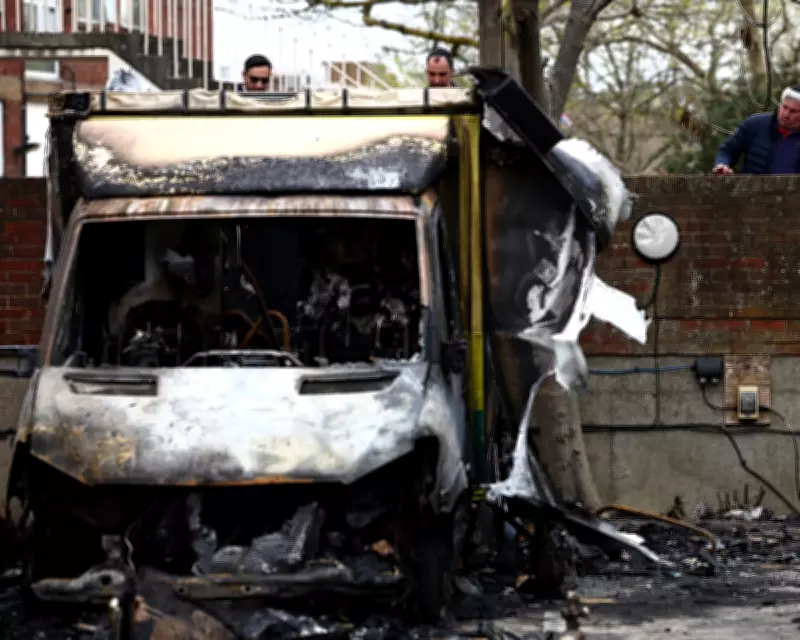
The arson attack on four ambulances belonging to a Jewish charity in Golders Green, north London, is currently being investigated as an antisemitic hate crime. The incident occurred in the early hours of Monday, with the burnt-out vehicles discovered at the scene. British authorities, including Metropolitan Police head Mark Rowley, have described a "very relevant and rolling threat" from Iran to the UK, particularly targeting Jewish communities, but caution that it is too early to attribute this specific attack to Tehran.
Experts Point to Iranian Involvement Amid European Wave
While investigators remain circumspect, security experts and officials are less hesitant, noting that the attack bears the hallmarks of Iranian intelligence operations. This incident is part of a series of similar low-tech incendiary attacks on Jewish sites across western Europe in recent weeks. For instance, on 9 March, an improvised explosive device was detonated outside a synagogue in Liège, Belgium, followed by another in Rotterdam four days later. Further attacks targeted a Jewish school and commercial centre in Amsterdam, with two teenagers arrested in Antwerp for torching a vehicle outside a Jewish-owned business.
These events coincide with heightened tensions following US and Israeli offensives against Iran. The Islamic Revolutionary Guard Corps's al-Quds force issued a warning, stating that enemies "will no longer be safe anywhere in the world." Since the conflict escalated, attacks linked to Iran have been reported in Azerbaijan, Kuwait, Qatar, and the United Arab Emirates.

Unraveling the HAYI Group and Iranian Tactics
Media coverage has focused on a video posted by a group calling itself Harakat al-Ashab al-Yamin al-Islamia (HAYI), which claimed responsibility for the Golders Green attack and referenced a "historic bond" with the local synagogue. However, security officials close to the investigation suggest that HAYI may not exist as a genuine group but rather serve as a front invented by Iranian intelligence or the Quds force. The video was first broadcast on social media channels affiliated with Asaib Ahl al-Haq, a pro-Iranian Shia militia supported by the Revolutionary Guards.
Iran has a long history of using unconventional attacks to maintain plausible deniability in conflicts with more powerful adversaries. Recent trials in Sweden, Greece, and the US have revealed how Iranian intelligence recruits individuals, often through criminal networks, to carry out operations. For example, two Iranians were recently charged with conducting hostile surveillance on London's Jewish community for Tehran, and a Pakistani man was convicted in Brooklyn for planning assassinations of US political figures as part of an Iranian plot.
Context of Rising Antisemitism and Non-Lethal Messaging
The Golders Green attack is being treated as a hate crime rather than a terrorist incident, leaving open the possibility that it was carried out by independent actors. It follows an attack on a synagogue in Manchester less than six months ago. According to the Community Security Trust (CST), the UK recorded 3,700 antisemitic incidents in 2025, marking the second-highest level ever and a 4% increase from the previous year.
Expert Magnus Ranstorp notes that the recent wave of attacks has been non-lethal, suggesting Iran is intentionally avoiding fatalities to send a message without escalating to full-scale retaliation. "The Iranians have a record of killing people or trying to kill people, so for them to clearly try quite hard not to kill anyone is interesting," he said. This strategy aligns with Iran's broader efforts to influence global perceptions while minimizing direct evidence of involvement.
As investigations continue, the tangled trail from Golders Green underscores the complex interplay between state-sponsored activities and local hate crimes, highlighting ongoing challenges in UK security and counter-terrorism efforts.