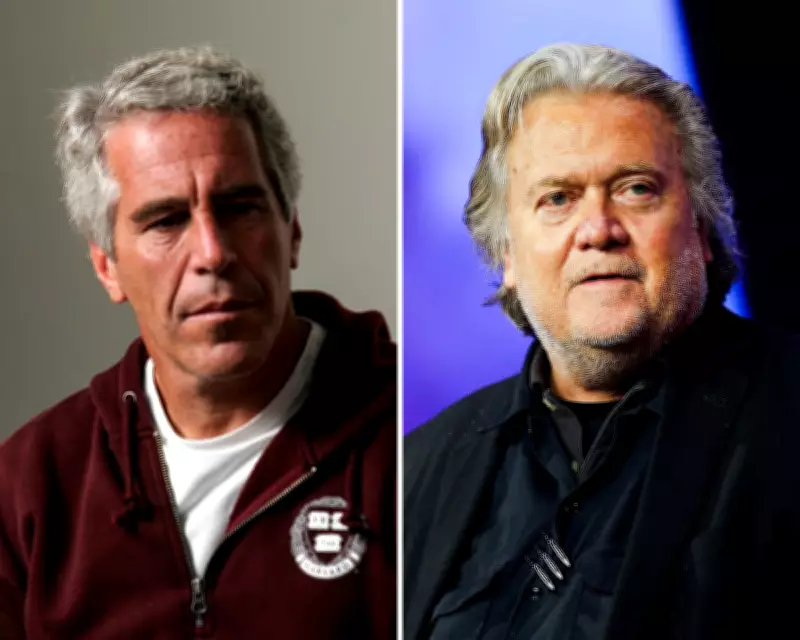
Bizarre Bannon-Epstein Interview Unveiled in Latest Document Release
The latest tranche of Jeffrey Epstein files has revealed a highly unusual video interview conducted by Steve Bannon, the former adviser to Donald Trump, with the disgraced financier. This nearly two-hour conversation, filmed around 2019 at what appears to be Epstein's New York residence, was reportedly intended for a sympathetic documentary aimed at rehabilitating Epstein's tarnished reputation.
An Esoteric Exchange Between Unlikely Allies
Steve Bannon, who has long positioned himself as a populist opponent of global elites, exchanged hundreds of friendly texts with Epstein, discussing topics ranging from politics to travel. The interview itself showcases an easy familiarity between the two men, allowing Bannon to provocatively label Epstein a "schmuck" and a "criminal," and even question whether he is "the devil" fallen from paradise. At one pointed moment, Bannon remarks, "There's something deeply fucked up with you."
Despite this candid tone, the dialogue often veers into intellectual peacocking, with references to Socrates, Isaac Newton, and quantum physics, while largely glossing over Epstein's heinous crimes. The footage includes a noticeable break midway, indicated by changes in Epstein's glasses and shirt, suggesting pauses in filming.

Notable and Strange Moments from the Conversation
On Intuition and Gender: Epstein shares controversial views, asserting that women possess an "intuitive sense" that men, particularly himself, find unexplainable. He claims, "Women have intuition. Men see things a bit differently. Men want to measure everything. Women are not really that interested in measuring."
On Racism: In an attempt to deflect accusations of racism, Epstein argues that intelligence varies among groups but is not superior or inferior. He uses a hypothetical scenario involving a lion in Africa to illustrate different types of intelligence suited to specific environments.
On Global Influence: Epstein outlines his rise from a trader at Bear Stearns to roles on elite boards like Rockefeller University and the Trilateral Commission. He attributes this ascent to a shift from character-based decisions to mathematical modelling in business, highlighting his outsider status by listing himself simply as "Jeffrey Epstein, just a good kid."
On Science and the Soul: Despite his mathematical background, Epstein expresses a firm belief in the soul, describing it as the "dark matter of the brain"—something intangible yet impactful. He references philosophers like Leibniz to argue that science cannot fully explain consciousness or life.
On the Ethics of 'Dirty Money': When Bannon challenges Epstein on whether institutions should accept funds from a "tier-one sexual predator," Epstein defends his philanthropy, such as funding polio vaccines in Pakistan. In a tense exchange, Bannon asks, "Do you think you're the devil himself?" to which Epstein retorts, "No. But I do have a good mirror."
On Global Finance and Illiteracy: Epstein displays disdain for the financial understanding of world leaders and the public, claiming many view finances through the lens of a personal chequing account. He explains concepts like fractional reserve banking, which he says is "impossible to believe" for the average person.
On the Santa Fe Institute: Epstein admits that his funding of the Santa Fe Institute to "mathematise" complex systems was a "total failure," concluding that unpredictable phenomena like stock markets are inherently miraculous rather than mechanical.
On Writing: In a peculiar segment, Epstein argues that teaching children to write may be harmful, as it enforces linear thinking. He notes that great thinkers like Socrates never wrote, relying instead on speech.
On the 2008 Financial Crisis: Epstein recounts experiencing the crisis from jail, where he was serving time for prostitution-related charges. He characterises the collapse as a biological system failure, blaming Bill Clinton for pushing homeownership to gain votes, which led to subprime lending.

On Refusing Responsibility: When pressed by Bannon on how he ended up in jail, Epstein repeatedly avoids taking responsibility for his crimes, describing his life as "incredible" and identifying as a hermit rather than a stoic.
On Populist Politics: Bannon briefly touches on anti-establishment sentiments, linking them to the populist movement and those who feel left behind by elites, though he avoids direct mentions of Trump.
On the Measure of Man: In a final abstract exchange, Bannon questions when human life begins, to which Epstein evades, stating it cannot be measured and joking about his avoidance of commitments.
Context and Aftermath
Epstein was arrested in July 2019 and died in his jail cell the following August. Bannon, who has also faced legal issues, including prison time in 2024, has not been accused of criminal wrongdoing in connection with Epstein. This interview adds a layer of complexity to Bannon's public persona, revealing his engagement with a figure he ostensibly opposes. The release of these files continues to shed light on the networks and conversations surrounding Epstein, prompting further scrutiny into the intersections of power, finance, and crime.